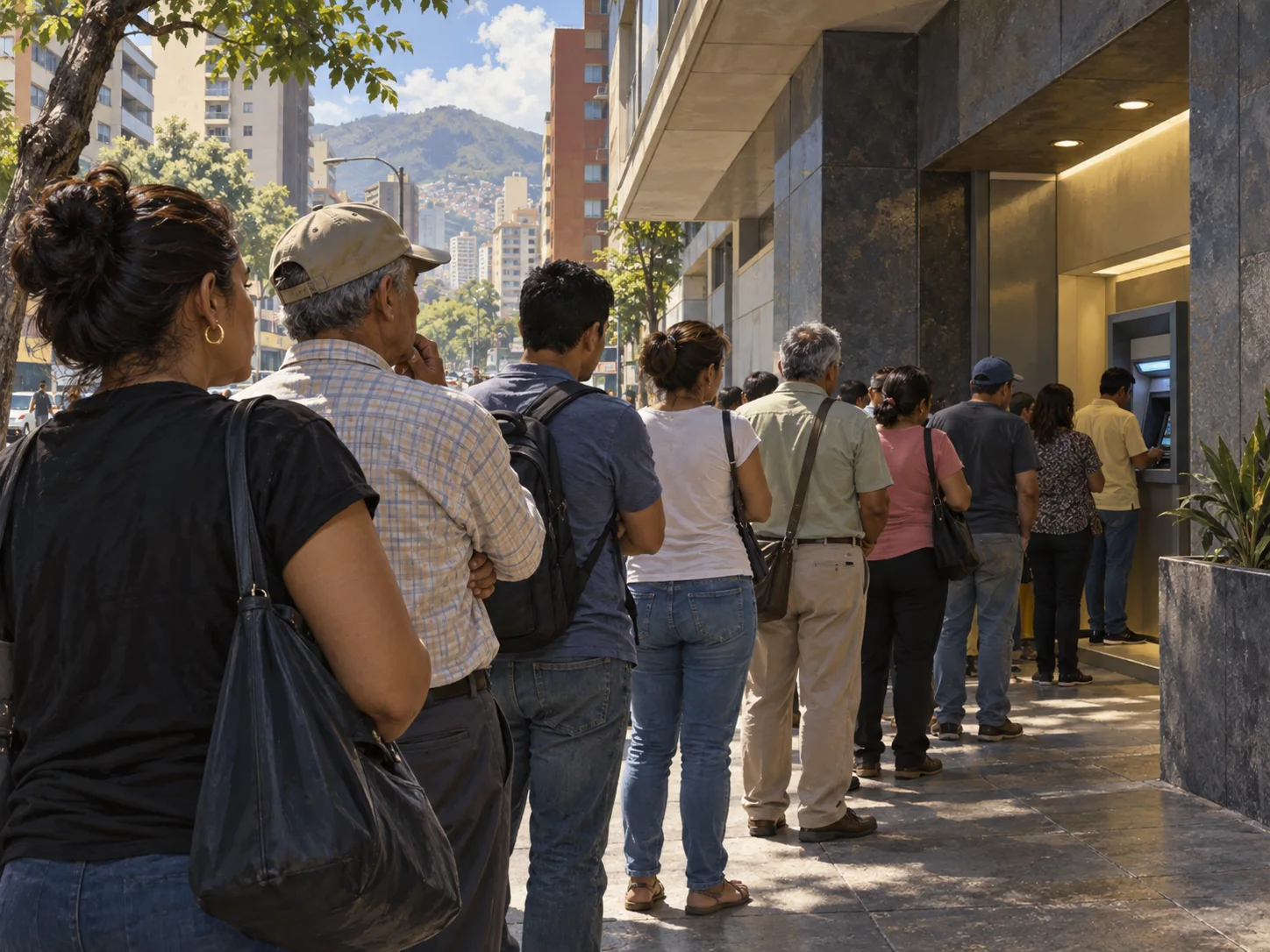
On 14 March 2017, people stood in line outside a Banco de Venezuela branch in Caracas to withdraw cash from an ATM. Reuters photographed the scene and recorded its date and location. This was not a queue for a coveted launch or a limited-edition treat. The thing being sought was banknotes—ordinary money that people needed to put to work in ordinary life.
Venezuela was experiencing severe inflation and disruption to the availability of cash. A balance displayed on a bank account and notes that can be handed over in a shop may both be called money, but they are not interchangeable in every circumstance. How much cash a machine holds, and whether customers can actually obtain it, can become obstacles long before anyone reaches a shop counter. The photograph establishes that the line existed; it does not establish every person's reason for joining it, or exactly how long each waited.
An ATM is supposed to reduce the need to queue at a staffed counter. Yet placing a machine on a street is not the same as guaranteeing access to cash. When the physical supply fails to match people's needs, technology can relocate a queue rather than eliminate it—from inside the bank to the pavement outside.
It would be easy, and wrong, to turn the image into an exotic spectacle of hardship. Its more unsettling detail is the familiar one. People everywhere know what it means to wait their turn at an ATM. What changes is the weight of that wait when access to your own money becomes uncertain.
An ATM may be automatic, but the notes loaded into it are finite. The line exposed how even a counter without a clerk still has an effective opening time and an inventory.