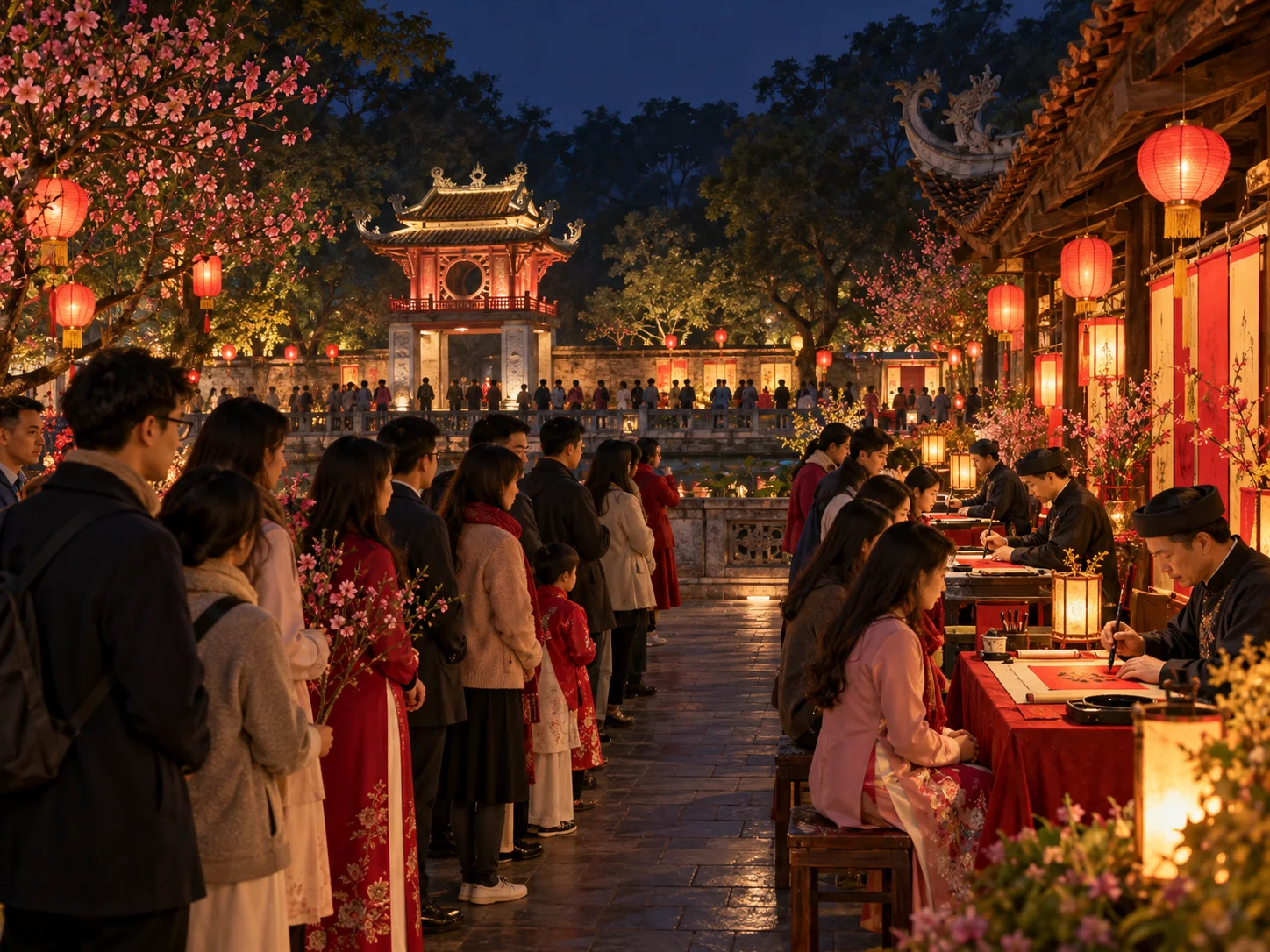
Before reaching the calligrapher, a visitor must compress the year into one character.
Founded in 1070, the Temple of Literature is closely associated with scholarship. Students and parents came with examinations in mind, while others sought language for health, work or family security. The waiting process therefore contained several small decisions: which calligrapher to approach, which character to request and how the composition should look.
Consultation and brushwork vary for every person, resisting standard processing time.
On 18 February 2026, the second day of the Lunar New Year, visitors arrived early at Hanoi's Temple of Literature to ask calligraphers for an auspicious word. Dantri recorded people considering characters associated with happiness, peace or learning as they waited. This was not simply a purchase from a shelf. The visitor chose a word, spoke with a writer and watched fresh ink turn an intention into an object.
A single character can take only moments to write, but choosing it may require much longer. Instead of listing every hope for the year, a visitor must decide which one deserves to come first. The queue was partly for an available brush. It was also for the quieter act of naming the year before living it.
The shortest word carries all the hopes that were not chosen.
Early on the second day of Lunar New Year 2026, visitors gathered at Hanoi’s Temple of Literature for calligraphy, causing congestion nearby. They were not waiting for a ready-made object, but for a writer to give form to a chosen wish—study, success or peace—one sheet at a time.