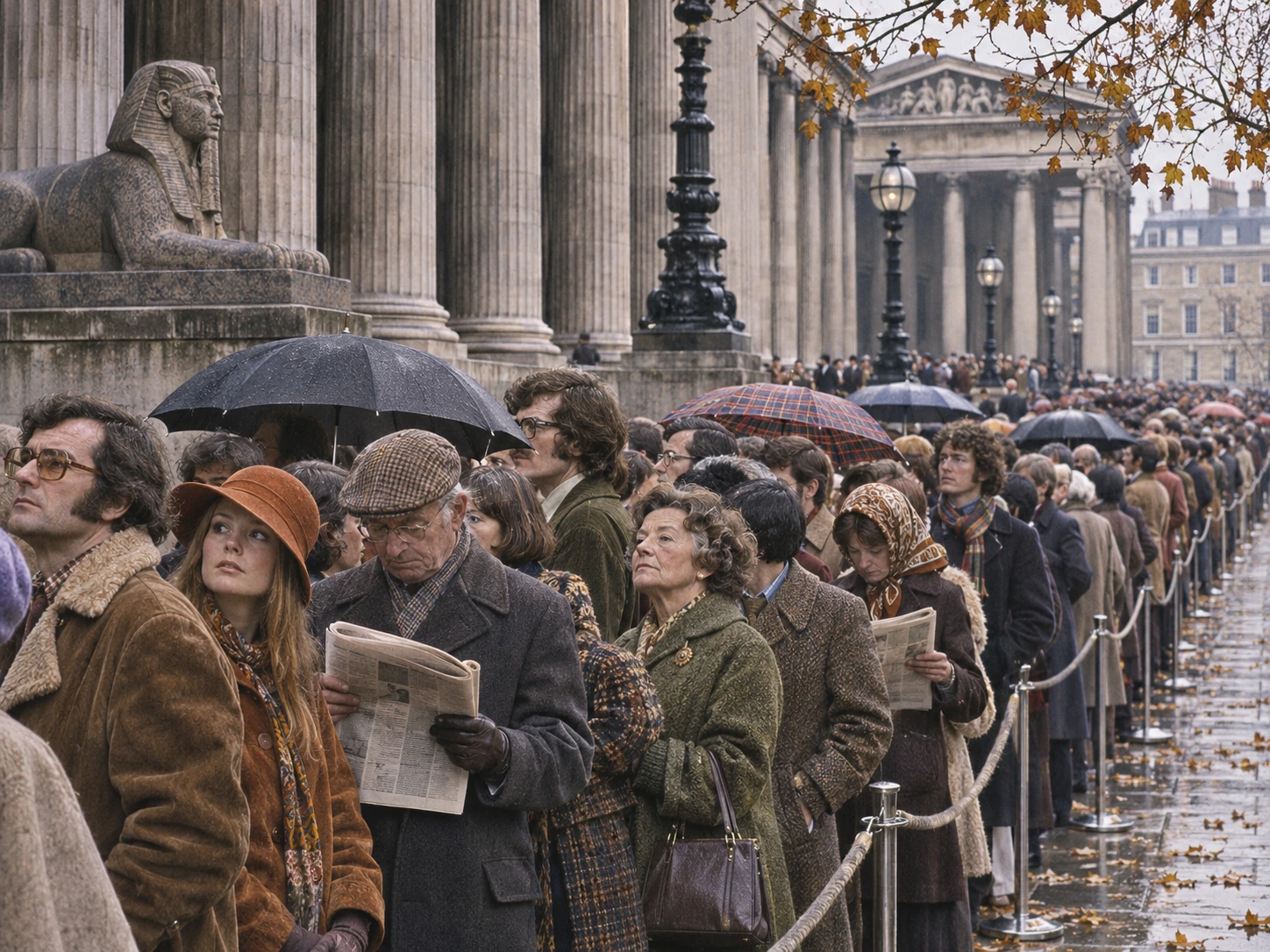
London, 1972. The line for Treasures of Tutankhamun at the British Museum ran from the upstairs exhibition area through the building, across the forecourt and out to the pavement. One photograph preserved by London Museum does not show visitors admiring a glittering object. It shows a family sitting down while they wait. The picture records an often-missing part of blockbuster art history: what people did with their bodies before they were allowed to look.
The exhibition marked fifty years since the discovery of Tutankhamun’s tomb. It opened on 30 March and was originally planned for roughly six months, but extraordinary demand kept it running until December. London Museum records a total audience of 1,694,117, the largest the British Museum had attracted to an exhibition at the time. Objects from ancient Egypt had altered the daily geography of modern London: gallery, staircase, courtyard, street, all became stages of the same visit.
The tomb uncovered by Howard Carter and his team in 1922 had become famous for the extraordinary objects it contained. Yet the people in the 1972 queue were not waiting merely for an image of gold; those could be found in books and newspapers. They were waiting for proximity to the things themselves. Fifty years after the excavation, the promise of seeing an object in person could still persuade visitors to surrender hours of an ordinary day.
There is a peculiar mismatch of timescales here. Objects that had survived across millennia required their modern audience to spend a few hours in line. The queue was an entrance to the ancient world, but it was also a very contemporary social space, complete with tired legs and families sitting on the floor. Their waiting belongs to the exhibition’s history just as surely as the treasures in its cases.
Visitors kept their places for a glimpse of objects far older than the hours they spent waiting. At the Tutankhamun exhibition, the museum entrance became an exhibit in modern urban culture.
The London Museum records that the 1972 Tutankhamun queue ran from the first-floor gallery, through the forecourt and onto the pavement. The extended exhibition drew 1,694,117 visitors. A family sitting while they waited turns that enormous total back into the bodily experience of one day.