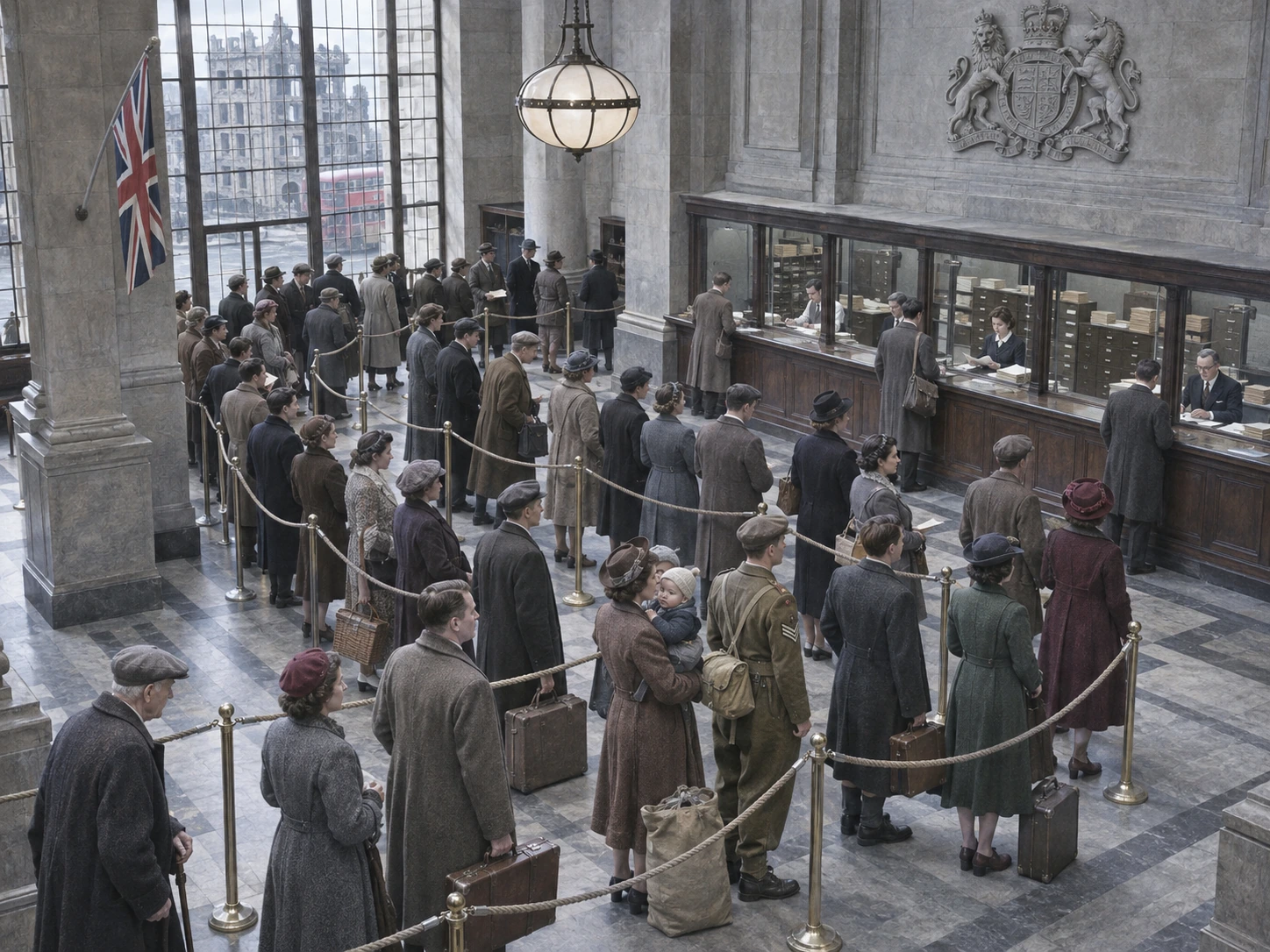
On 8 July 1946, less than a year after the end of the Second World War, queues at Britain’s passport offices became a practical question in the House of Commons. One MP said applicants were standing for as long as eight hours before being attended to and noted that mothers with children were among them. Another asked whether seats could be provided inside the building. The government replied that the London Passport Office already had seating for about 150 people and that a few more chairs were being installed—the maximum considered practicable. The response reveals an unusually concrete dimension of administrative delay: officials were discussing not only how applications moved, but where waiting bodies could be placed. The parliamentary question also relayed complaints that some applicants secured earlier attention through bribes. The minister rejected the implication and asked which of the three passport offices was meant, so the allegation cannot be treated as established by this exchange. The queues, their possible eight-hour duration, the presence of children and the limited seating, however, are directly recorded in Hansard. As post-war international travel resumed, the office had not made the process frictionless. The gap between an eight-hour wait and roughly 150 seats captures the burden before a passport could even be issued. The request for additional chairs shows that the queue was large enough to be treated as a problem of building capacity, not a momentary inconvenience. Passport history is therefore recorded not only in documents and border rules but also in floor space, seating and the practical limits of a public office.
United Kingdom · 1946
Eight Hours for a Passport in Postwar Britain