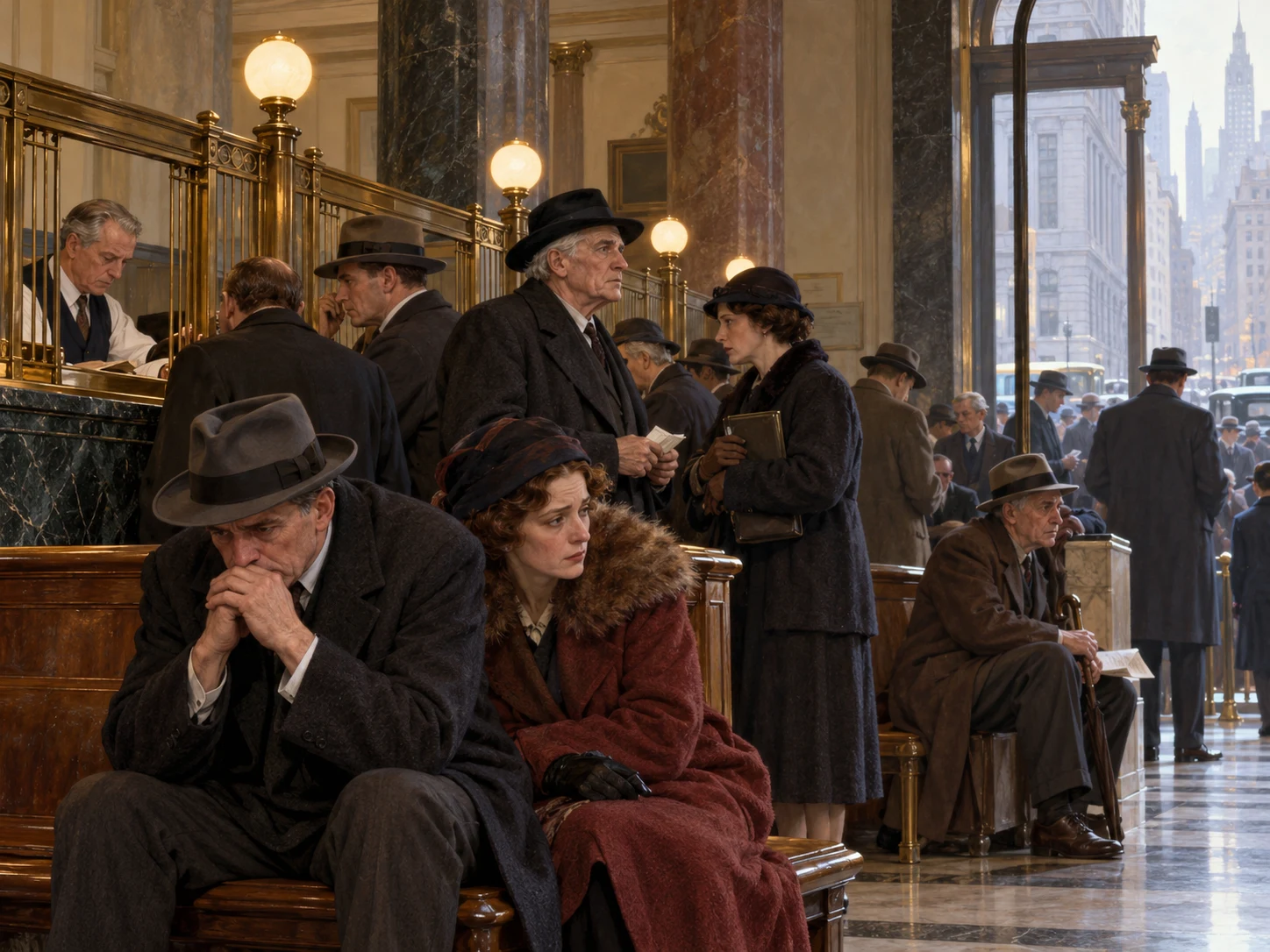
After the Bank of United States failed in December 1930, depositors gathered in the rain outside a New York branch. The Library of Congress catalogue identifies the press photograph as a crowd after the bank's failure and classifies it under bank runs. These people were not applying for loans or opening accounts. They were seeking access, in cash, to deposits that still existed on paper.
A run becomes more real as fear passes from customer to customer. Banks do not keep every deposit simultaneously available as notes, so concentrated withdrawals can outrun counter capacity and available cash. Here the institution had already closed. The gathering was not an ordinary business-day line; people wanted information, repayment and instructions about what came next.
The photograph cannot tell us each person's waiting time or eventual recovery. It does show that a financial crisis is more than a balance-sheet event. Bank confidence is normally invisible. On the day it collapsed, it appeared as umbrellas and bodies outside a locked door, each person waiting for the possibility that a name or claim might be recognised.
Despite its official-sounding name, the Bank of United States was a private institution. Historians have noted that the name could encourage assumptions of security. For depositors discovering a closed branch, the contrast between the authority implied by the sign and the inability to obtain cash made the collapse of trust especially concrete.