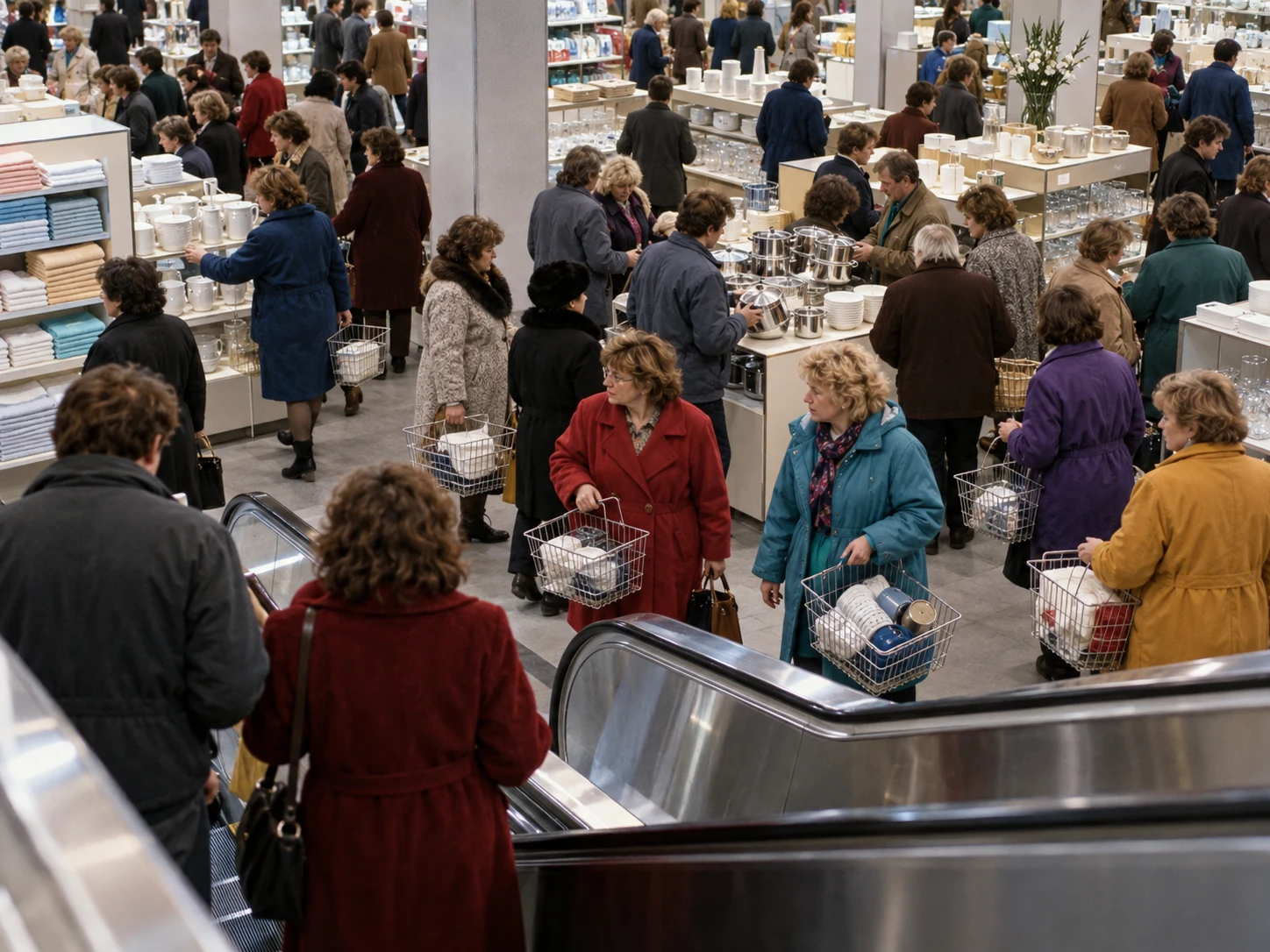
After the Berlin Wall opened in November 1989, East Germans poured into KaDeWe, West Berlin's great department store. A German public-history site reports that as many as 200,000 visitors entered on some November days. Banks also had queues of East German citizens collecting the “welcome money” provided in the West. Bananas, coffee and clothing were not just merchandise. For people whose movement and consumption had been restricted, they were objects through which western daily life could be inspected at first hand.
Two waits overlapped. Visitors might first queue for the cash payment and then wait to enter the crowded store, examine goods or reach a till. Opening the concrete border did not remove the limits created by currency, building capacity and checkout speed. Reducing the scene to fascination with western consumption would miss how travel and shopping became practical tests of a freedom long denied. German unification was not yet legally complete, but at KaDeWe's doors a geopolitical division was already being translated into something radically ordinary: baskets, banknotes and turns in a retail line.
The welcome payment acted as a temporary bridge that let East Germans purchase western goods. The bank queue and the department-store queue were therefore not unrelated crowds, but stages in one route from currency to consumption. When the political boundary weakened, one of the busiest destinations was not a ministry but a sales floor.