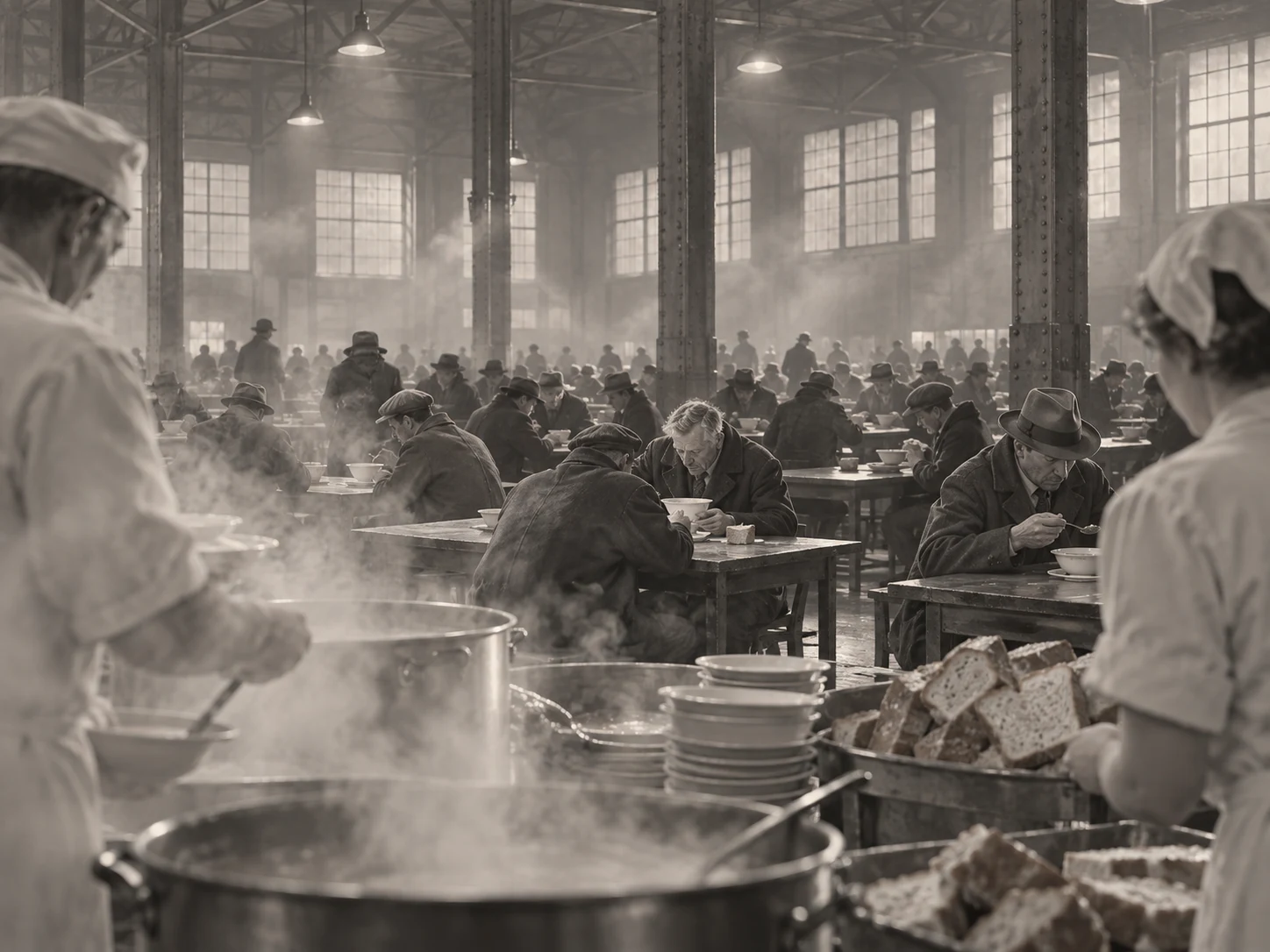
On 4 November 1930, men stood in a line on the lower level of Wacker Drive in Chicago, waiting for soup and bread. The Library of Congress preserves a photograph identified with that date, that location and that purpose. Its catalogue does not tell us the men's names, how long any particular person had been out of work, or what happened after the picture was taken. Those limits matter as much as the details that survive.
Wacker Drive is a layered piece of urban infrastructure, built to move people and goods through the city. The phrase “lower level” makes the geography unusually precise. Above and around this space, Chicago continued to function as a place of deliveries, commerce and movement. Below, in the year after the 1929 crash, access to a simple meal involved standing in line. Economic collapse was not only a number on a financial page; it changed the routes people had to take through an ordinary day.
It is tempting to treat a Depression-era soup line as a generic image of hardship. But the photograph is evidence of one queue at one place and time, not a record of every unemployed Chicagoan. The catalogue does not establish who provided the food, how long the wait lasted or whether everyone was served. A careful account should not turn the men into an undifferentiated symbol simply because their individual stories are unavailable.
People in many queues want the front to move. Here, reaching it was not about getting a coveted novelty or a better view. It was about food. That distinction should not be softened by a clever comparison. What the Wacker Drive photograph allows us to see is something quieter and more exact: a city can have elaborate systems for keeping traffic moving, while people still have to wait for the most basic things that sustain a life.
The photographed distance records more than the amount of soup available. It preserves the time required to reach relief in Chicago in 1930, when a meal became real one position at a time.