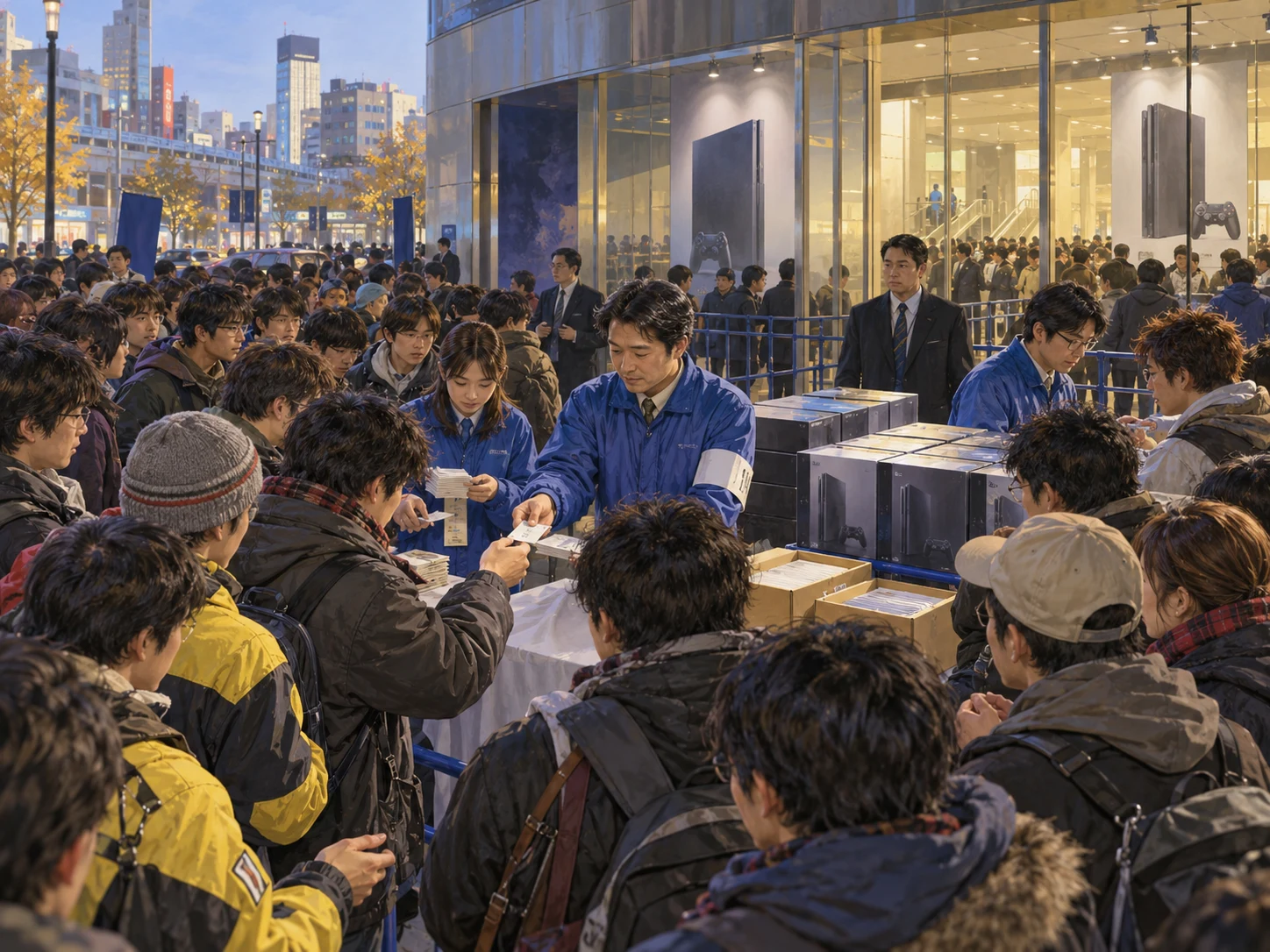
Akihabara, Tokyo, on the evening of 3 March 2000. Outside the LaOX GAME store, people were waiting for Sony’s PlayStation 2, due to launch the following morning. Contemporary reporting counted more than 300 in line around 4 p.m. and over 500 by 8 p.m., when the queue had curled around the station plaza. Some customers had brought blankets and sleeping bags. Others read comics or played UNO. Waiting for a games console was becoming a communal game of its own.
On 4 March, staff reorganized the crowd into four lines and began issuing numbered tickets around 6:30 a.m. Sales started at 7 a.m., but new customers emerging from the station continued joining the queue. Reports from Shinjuku, meanwhile, estimated around 2,500 waiting at one retailer late the previous evening. That was a different store and a different count; Tokyo did not form one giant, uniform PlayStation line. Each shop had its own stock, rules and pavement to manage.
PlayStation 2 was marketed not just as a machine for games but as a device that could play DVDs. Online reservations were also part of this supposedly futuristic launch, yet news reports described the advance-order website buckling under the rush. The physical queue and the digital bottleneck were two versions of the same problem: too many people trying to reach a scarce opening at once. At street level, one answer was strikingly old-fashioned—a paper ticket with a place in line.
Not everyone waited for exactly the same reason. Some wanted to play immediately, others wanted to own the newest device before their friends did, and some planned to use it as a DVD player. From a distance the customers looked like one crowd; up close they represented different hopes attached to the same black box. Once the shutters opened, the overnight queue would dissolve. The object inside the box, of course, was designed to absorb many more hours of human attention. They had spent a night unable to play in order to buy a machine that promised to change how they played.
A numbered ticket was not a console, but it temporarily made eligibility to buy one tangible. After securing the ticket, customers still faced payment and collection. A futuristic entertainment machine depended on the old technology of paper numbers.
PC Watch documented sales beginning at 7 a.m. in Akihabara on 4 March 2000. The launch happened everywhere at once, but the moment of possession still arrived one customer at a time, governed by numbered tickets and each shop’s capacity.