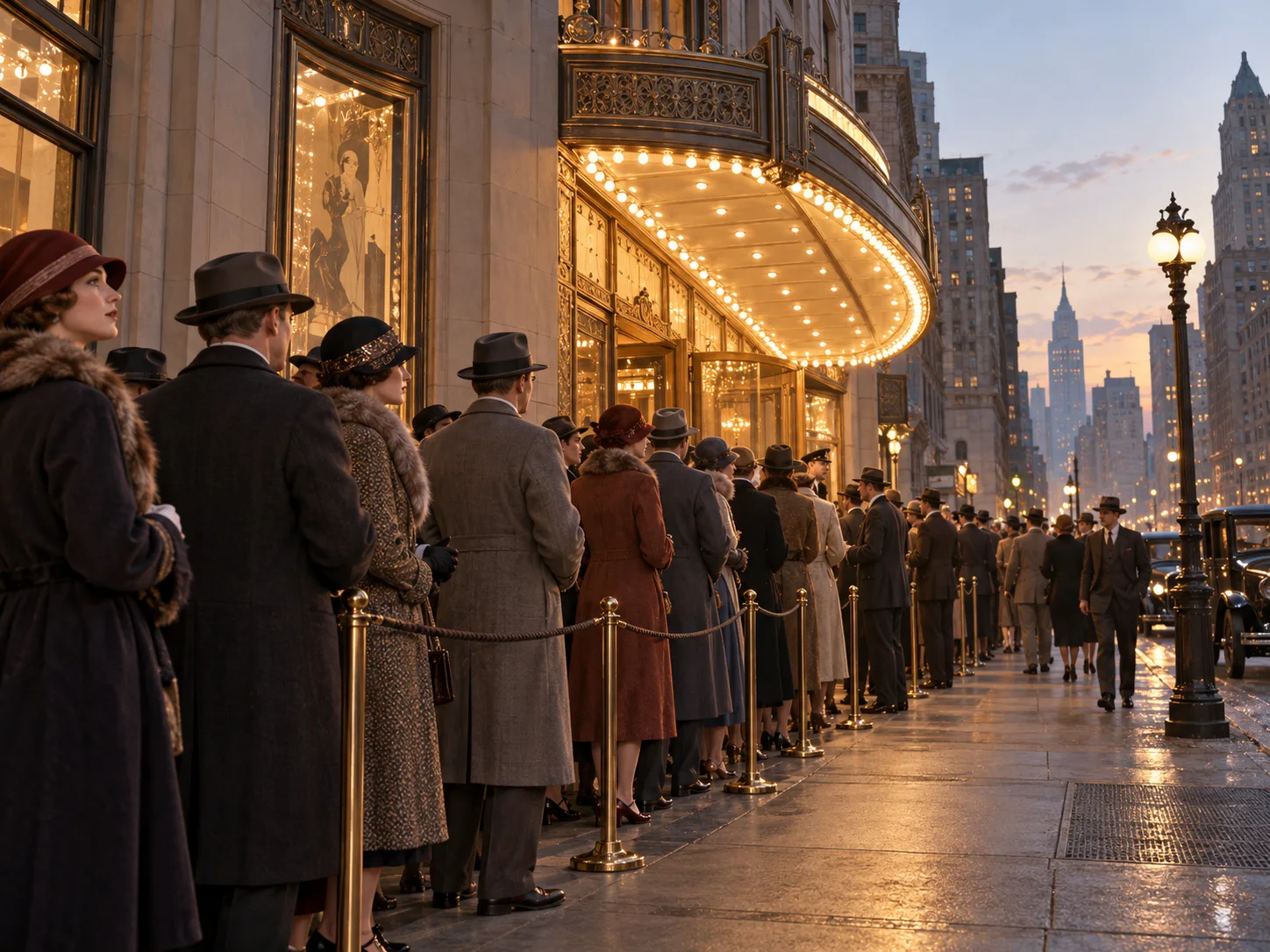
The Jazz Singer opened at New York's Warner Theatre on 6 October 1927. The audience was waiting for a film, but when Al Jolson's songs and spoken lines emerged in synchronisation with the picture, the cinema experience changed. The Library of Congress record places the release at a turning point in the history of synchronised sound.
Silent-era theatres had not been literally silent; orchestras and accompanists supplied music. The novelty was a performer's recorded voice attached to the film and reproduced at the same moment in each screening. People outside did not necessarily know they were queueing for a historical threshold. Curiosity about the promoted technology and interest in a famous stage entertainer brought them to the theatre.
The surviving institutional record does not support a precise crowd figure, so one should not be invented. The revealing fact is that the difference could not yet be heard while tickets were checked. Between the back of the line and the darkened seat, cinema changed from an image accompanied locally into a medium in which the actor's voice arrived on cue.
Much of the film retained silent-era intertitles, with synchronised sound concentrated in songs and selected speech. That mixture made the transition more striking. Cinema did not change all at once; a familiar kind of screening was interrupted by a voice. The admission line gathered an audience that had not yet crossed that sensory boundary.