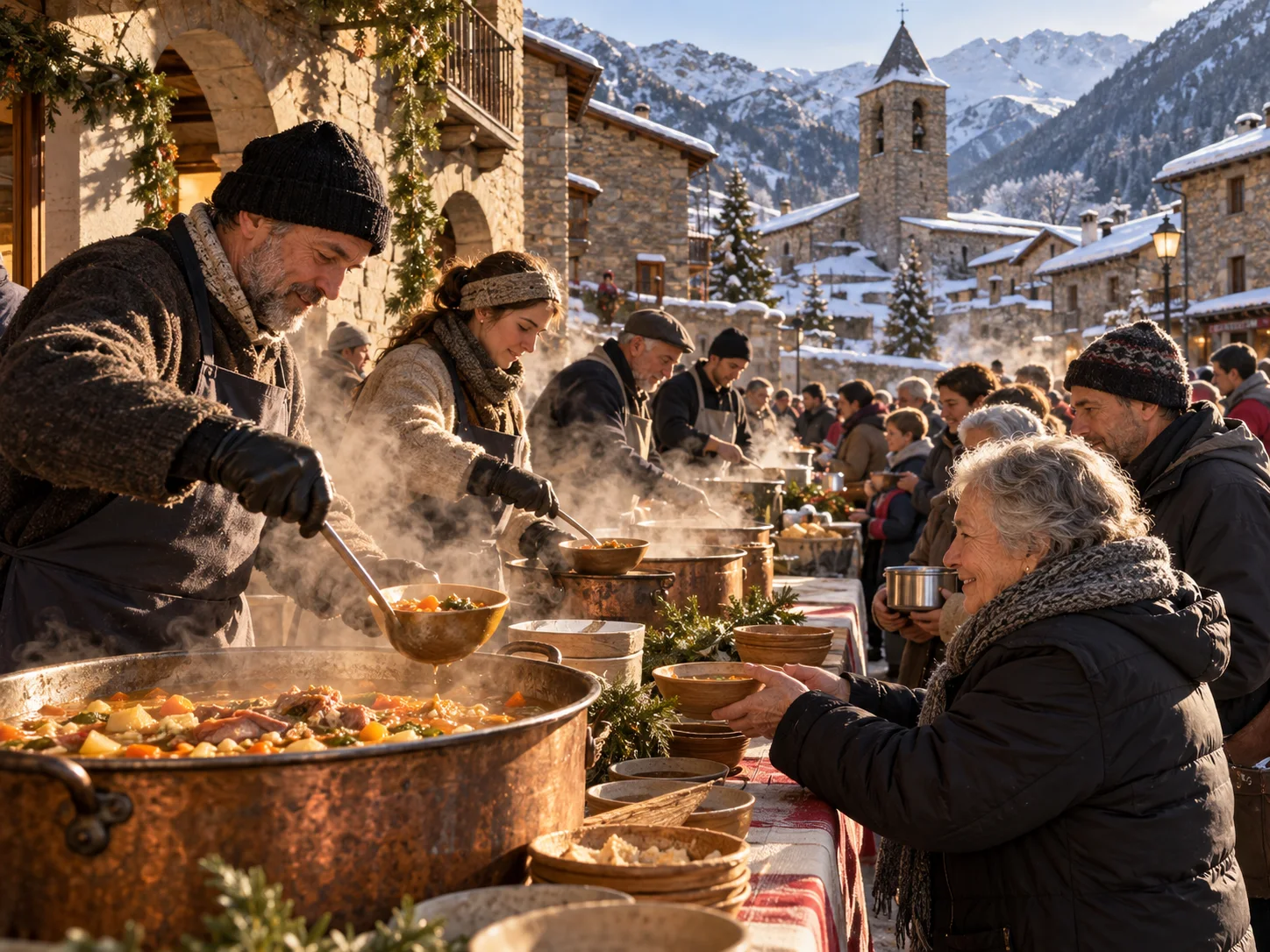
Before serving began on 17 January 2017, people were already queueing in Plaça Guillemó, Andorra la Vella. The temperature was −3°C. They were waiting not for a commercial product but for escudella cooked communally for Saint Anthony’s Day. The forty-eighth edition, organized by the city and the Confraria d’Escudellaires, prepared about 4,000 portions in ten large cauldrons. Ingredients had been prepared the previous day, and from 5 a.m. roughly fifty cooks—adults, young people, and children—worked beside the fires.
The municipal account records an important practical detail: because of the cold, many recipients did not remain in the square to eat. They collected the stew in containers and took it home. The line therefore served as more than the audience for a festival. It was the transfer point between a civic kitchen and thousands of household tables. In 2018, more than 4,000 portions disappeared in a little over half an hour. The city also published the scale of the recipe, including 1,400 litres of water and large quantities of meat, beans, vegetables, rice, and noodles.
The revived tradition dates to 1970, when friends who shared Saint Anthony as a name day decided to celebrate together. What makes this queue distinctive is the division of labour behind the bowl: preparation, fire tending, serving, and carrying the food home. The crowd waiting in sub-zero weather showed that the custom was not merely being preserved as folklore. It was still being cooked, portioned, and eaten.