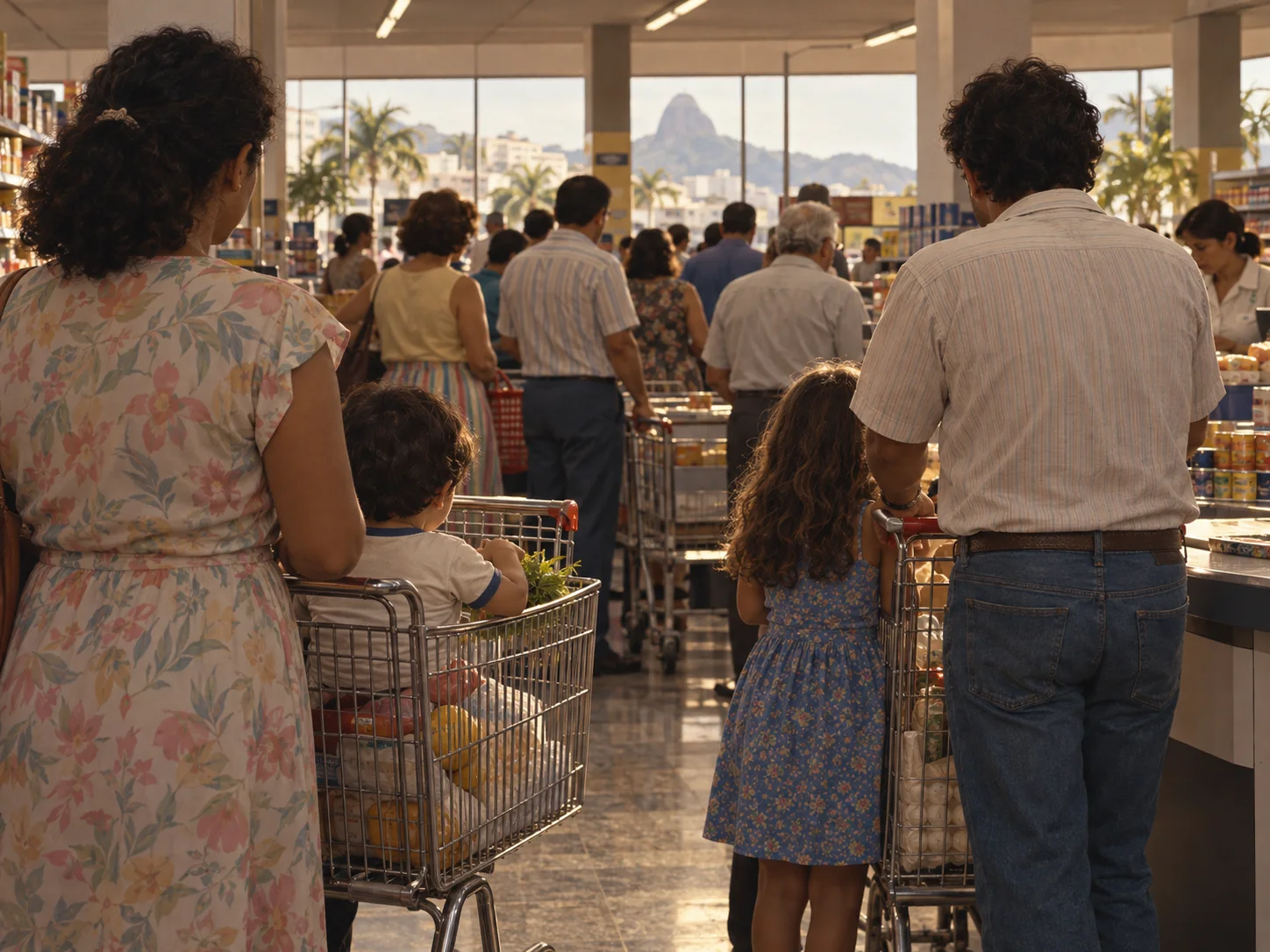
Inflation alone, however, does not prove that every supermarket had a long line. Crowded checkouts, stockpiling and queues for petrol are different events, each requiring evidence tied to a particular place and date. The economic background is real; a specific queue cannot be inferred from it.
During Brazilian hyperinflation, repricing competed with shopping. Payday crowds were not waiting for bargains; they were converting wages into necessities before the same notes bought less.
Brazil's severe inflation during the 1980s and early 1990s changed the rhythm of ordinary shopping. A price seen today could be different tomorrow. Spending wages quickly, watching prices and deciding when to buy necessities became part of household financial management. Shopping was not merely a transaction; it could feel like a race against time.
The Real Plan, introduced in 1994, was a major attempt to stabilise prices and currency. Its importance was not confined to economists or government offices. Stable prices also changed what a shelf label meant to someone planning tomorrow's meals.
Price controls could hold down the posted price while goods disappeared and informal-market premiums widened. Households chose between paying with time in an official queue and paying more money elsewhere.
Inflation supplies the context, not automatic proof of a checkout line. A record linking payday, store and date is still required before this defensive shopping can be described as a documented queue.