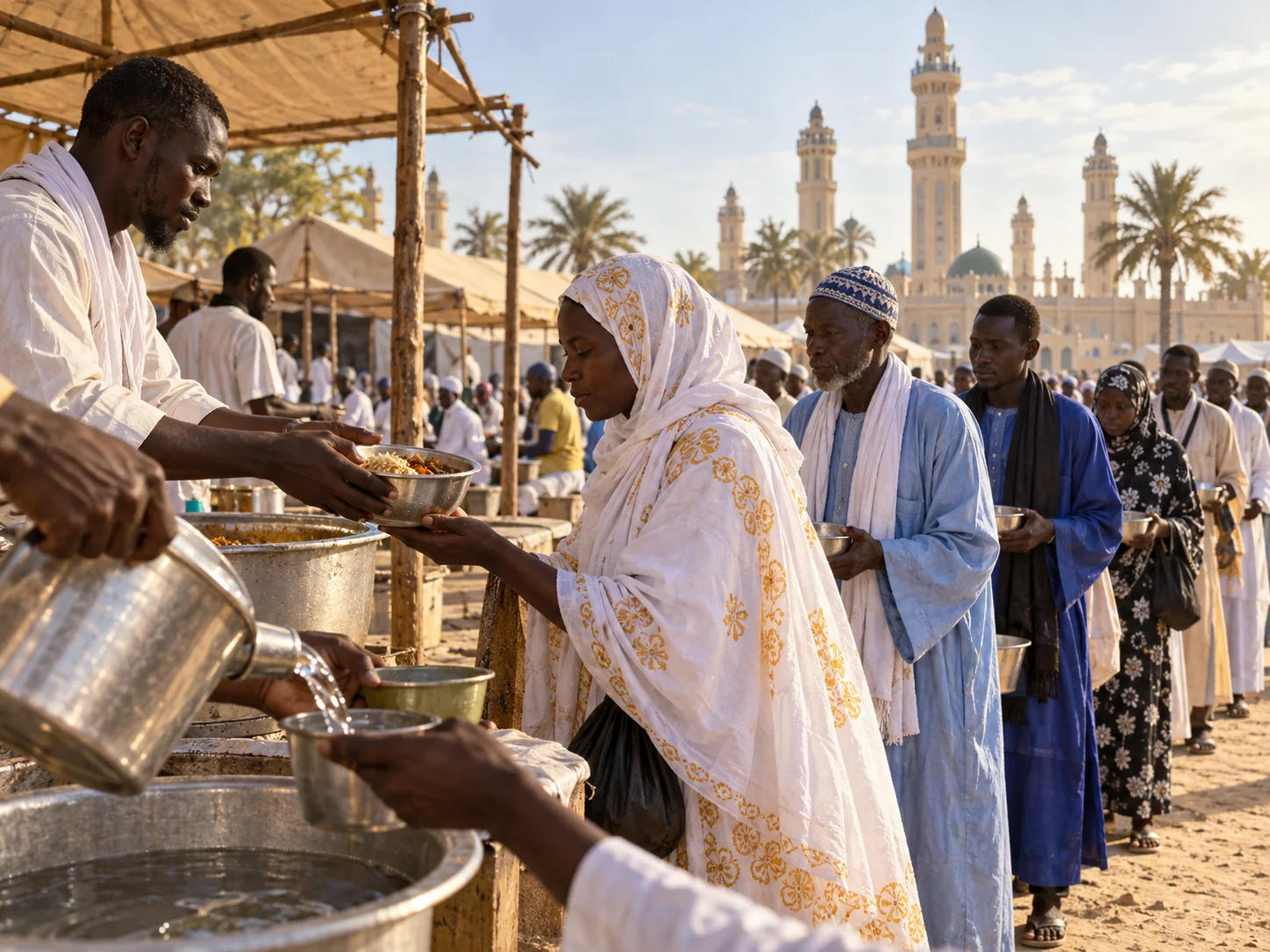
During the 2017 Grand Magal, hundreds of worshippers formed two long lines leading to Daaray Kamil, about fifty metres east of Touba’s Great Mosque. The official Grand Magal website recorded the lines moving slowly toward the beige building as pilgrims waited to perform the traditional ziar, or devotional visit. Police officers supervised the continuing flow at separate entrance and exit doors.
Daaray Kamil—often translated as the House of the Qur’an—is both a library and the mausoleum of Serigne Abdou Lahat Mbacké, the third caliph-general of the Mouride brotherhood. He led the community from 1968 to 1988, established the building in 1977 and was later buried inside it. During the Magal the library rooms were closed for security, while an exhibition on the life and writings of Cheikh Ahmadou Bamba was arranged on the esplanade. The collection is broader than its popular name suggests: alongside Qur’ans, it holds works on theology, Islamic law, grammar and other subjects, as well as correspondence involving Bamba and colonial officials.
This was not merely one of the service queues that inevitably appear when a vast pilgrimage needs food, water and transport. It was a line for the devotional act itself—to approach a remembered leader’s tomb and pray. The scale of the Grand Magal was translated into individual visits through two files and controlled doors. What makes the queue distinctive is that waiting was not simply the cost of crowding. It was part of the practical order that allowed hundreds of pilgrims to turn collective movement into successive moments of worship.