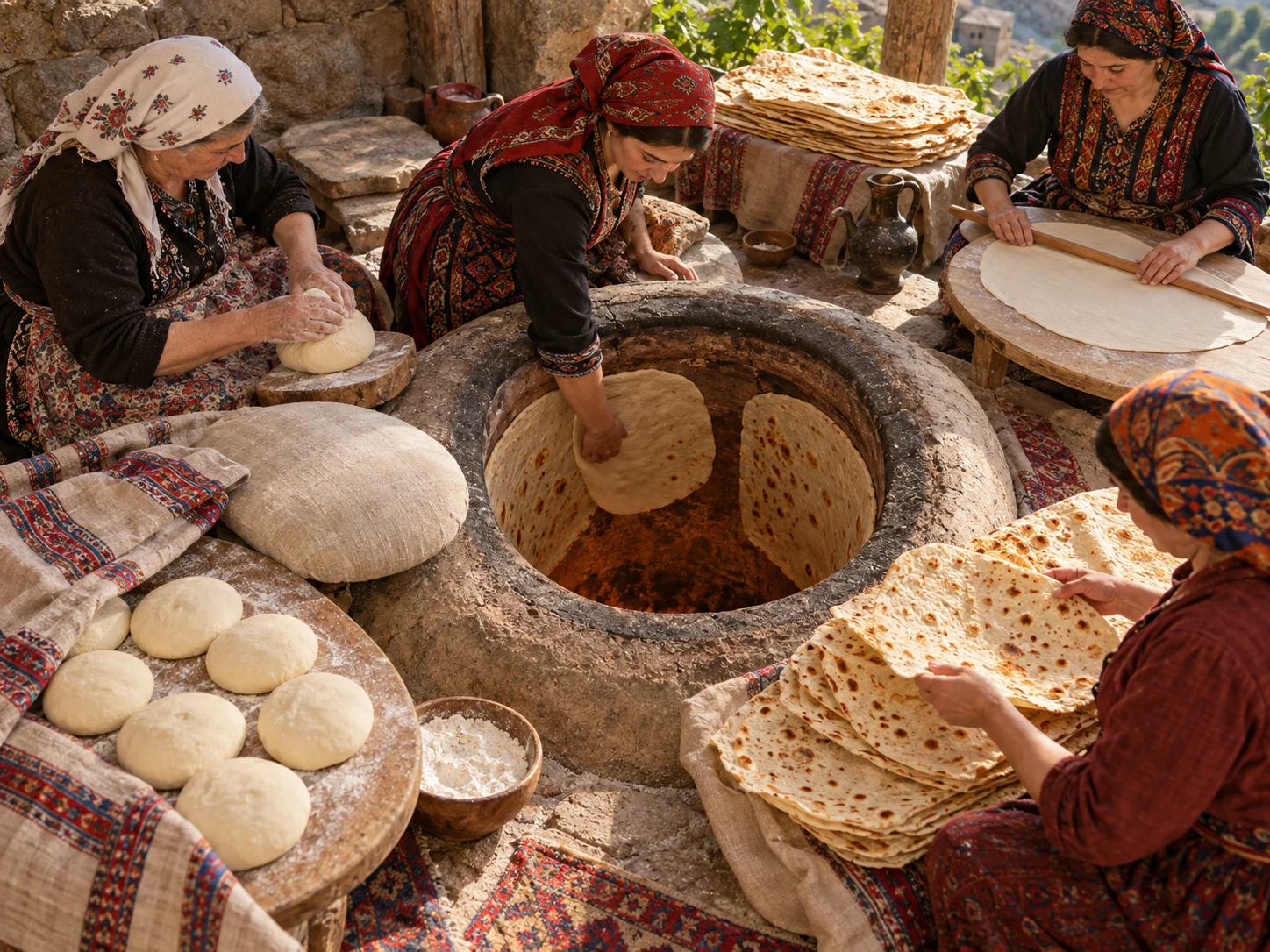
Making Armenian lavash is not the work of one baker alone. Dough is kneaded and divided, rolled and stretched, pressed against the hot inner wall of a tonir, and lifted out as a finished sheet. An ethnographic account states that several families in a village may share a tonir and bake bread in turn while helping one another. This is not a service queue at a counter. It is a community order shaped by a single oven, its heat, and a chain of coordinated tasks: one household or stage gives way to the next. Lavash is an everyday bread that keeps well, but it also appears at weddings and celebrations. With every thin sheet that comes from the oven, the center of the work passes quietly to another pair of hands. The setting is distinctly Armenian, yet the underlying habit is widely human: when time and a valued place are shared, people create an order for taking turns.
Armenia · Present day
Taking Turns at the Shared Tonir: Baking Lavash in Armenia