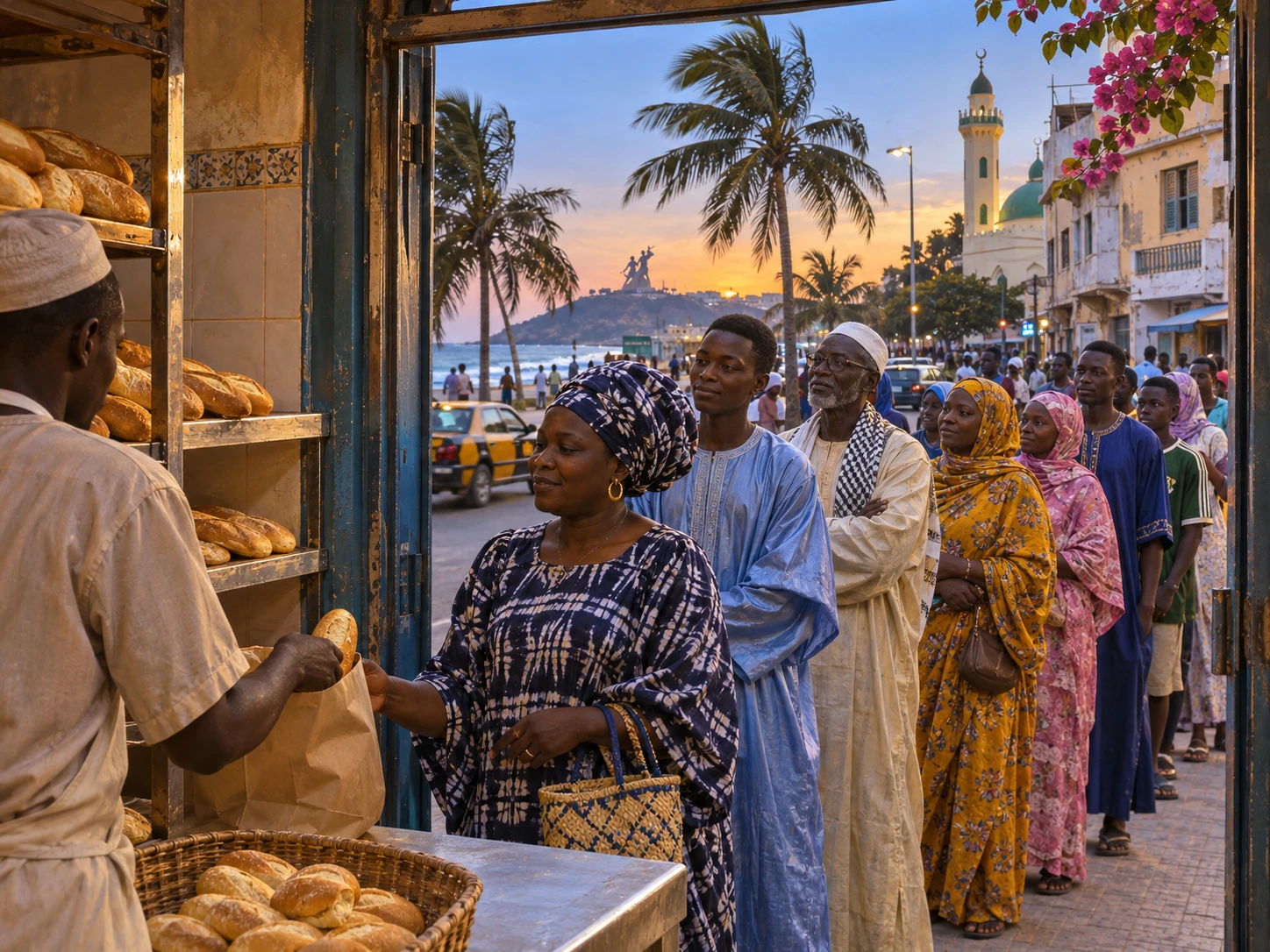
In March 2026, during Ramadan in Dakar, customers formed bakery lines in the hours before iftar, the meal that ends the day’s fast. A report accompanied by local footage recorded bakeries producing more than 4,000 loaves a day as evening demand reached its peak. The baguette was not simply a staple purchase: it was preparation for a meal shared at a fixed time with family and friends.
A Ramadan day is shaped not only by abstaining from food, but by the movement of an entire city toward sunset. At bakeries, batches coming from the ovens meet customers arriving within the same narrow window. Another Dakar report described the atmosphere outside a particular bakery intensifying from around 6 p.m. Once served, buyers left the line and hurried home in time for iftar.
The inherited candidate imagined a morning bakery queue. The physical line that can be directly documented in Dakar, however, occurred before the evening breaking of the fast. The country, city, and waiting target—buying baguettes at a bakery—remain unchanged; the time of day and Ramadan context have been corrected to the evidence. An everyday bread purchase thus becomes a queue synchronized by the city’s religious calendar.