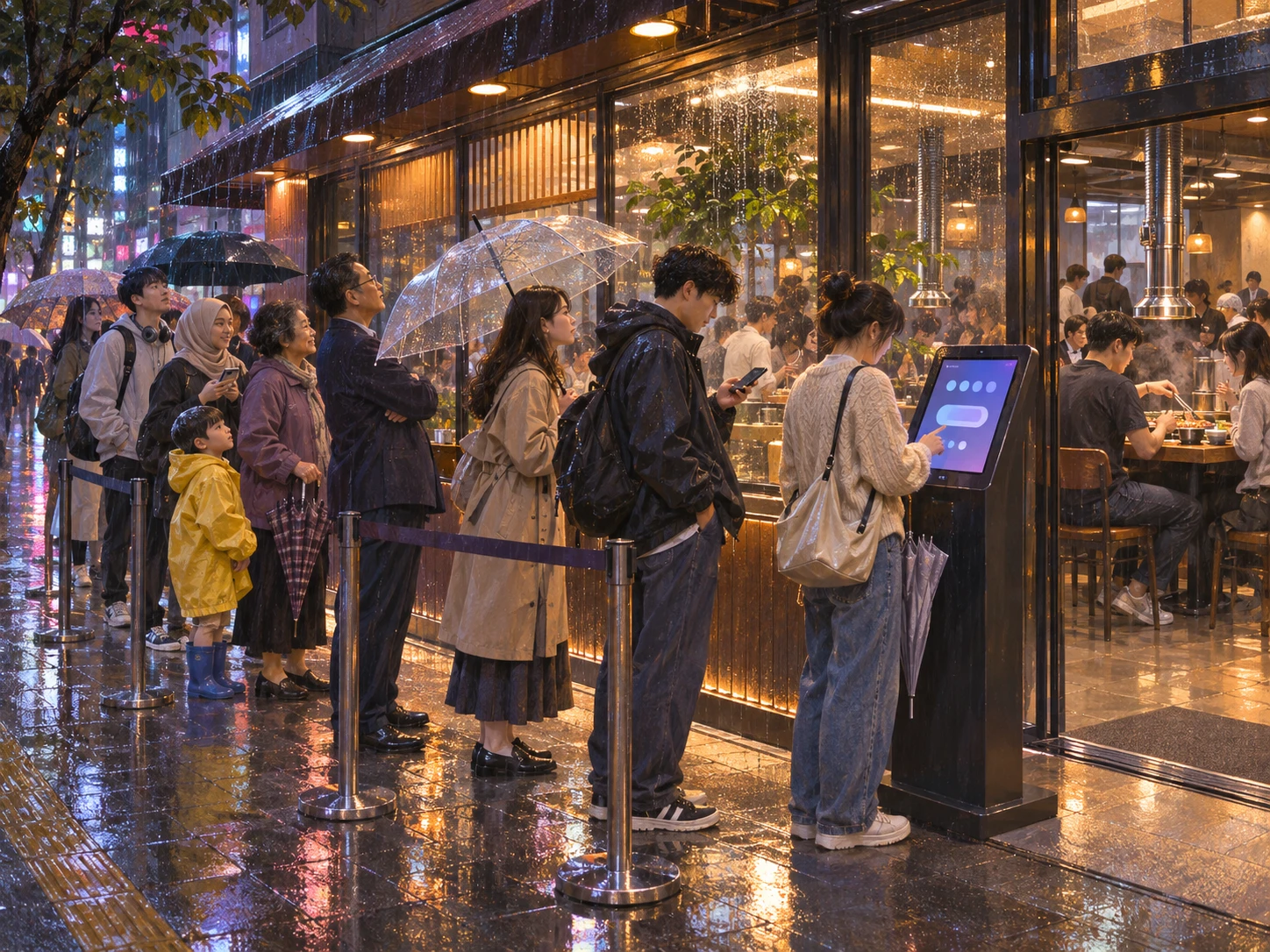
At popular restaurants in South Korea, waiting does not always mean remaining in one visible line outside the door. Guidance published by the Korea Tourism Organization describes restaurant services that support both on-site waiting and remote waiting. With on-site waiting, a diner joins the queue in person and registers for the waitlist; the service then manages the order and alerts the diner as the turn approaches. The guidance also explains the practical discipline of the system: arrive within the required time and do not miss the call. The digital layer therefore does not abolish the physical sequence. It reorganises it. After registering, customers may be able to move around nearby instead of crowding the entrance, but they must return, respond to the call and be seated in their recorded order. What once appeared as a paper list or a dense line at the doorway becomes a numbered queue distributed across phones and the surrounding streets. The crowd may be less visible, yet the essential features of a queue—entry, order, a call and eventual access to a table—remain firmly in place.
South Korea · Present day
South Korea | Joining a Restaurant Queue, Then Waiting for the Call