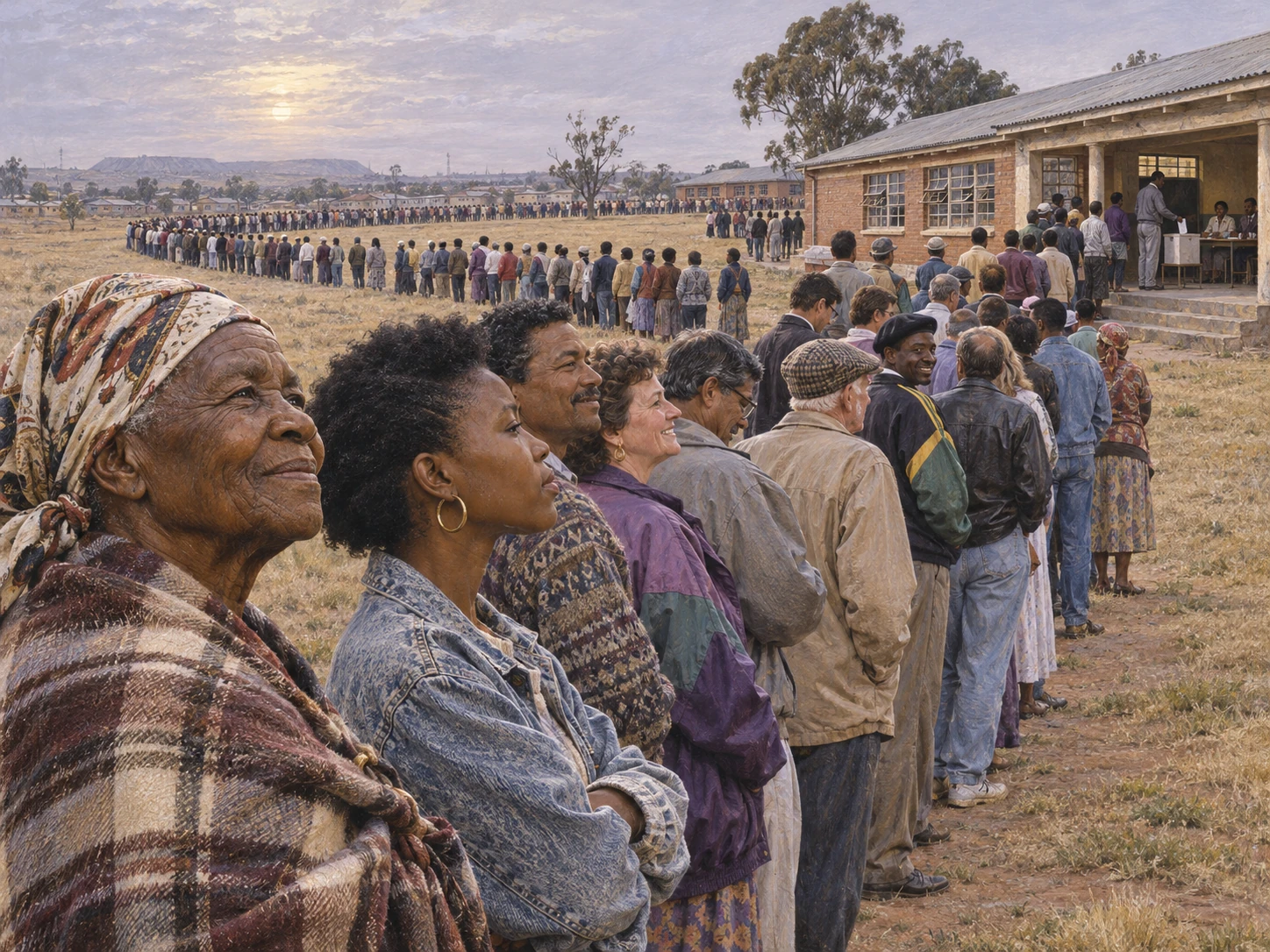
Before polling stations opened on 27 April 1994, queues were already stretching across South Africa. A United Nations report recorded lines several kilometres long at some stations before voting began. South African government retrospectives say nearly twenty million people queued to cast ballots in the country’s first democratic national election open to voters of every race after apartheid had denied political rights on racial grounds.
Symbolism alone did not produce the wait. The eligible electorate expanded at once, while the new election administration had to deliver ballots, registers and trained staff across the country. Political violence continued in the run-up to the vote, and some stations faced missing materials or organisational confusion. Voting extended from 26 to 29 April to accommodate the numbers, with the 27th becoming the central election day.
The Apartheid Museum notes that voters often stood for hours in lines extending more than a kilometre. An aerial photograph of a queue winding through fields beside a school in Soweto became one of the election’s defining images. Yet the length of a line cannot be treated as evidence that everyone supported the same party or imagined the same future. Nineteen parties appeared on the national ballot.
What the queue shared was a procedure, not an opinion. People who had long been denied the vote and people who had voted under the previous system entered the same election through the same sequence. The kilometres of waiting exposed administrative strain, but they also made a constitutional change visible on the ground: the country was redefining who counted as a voter, one person at a time.