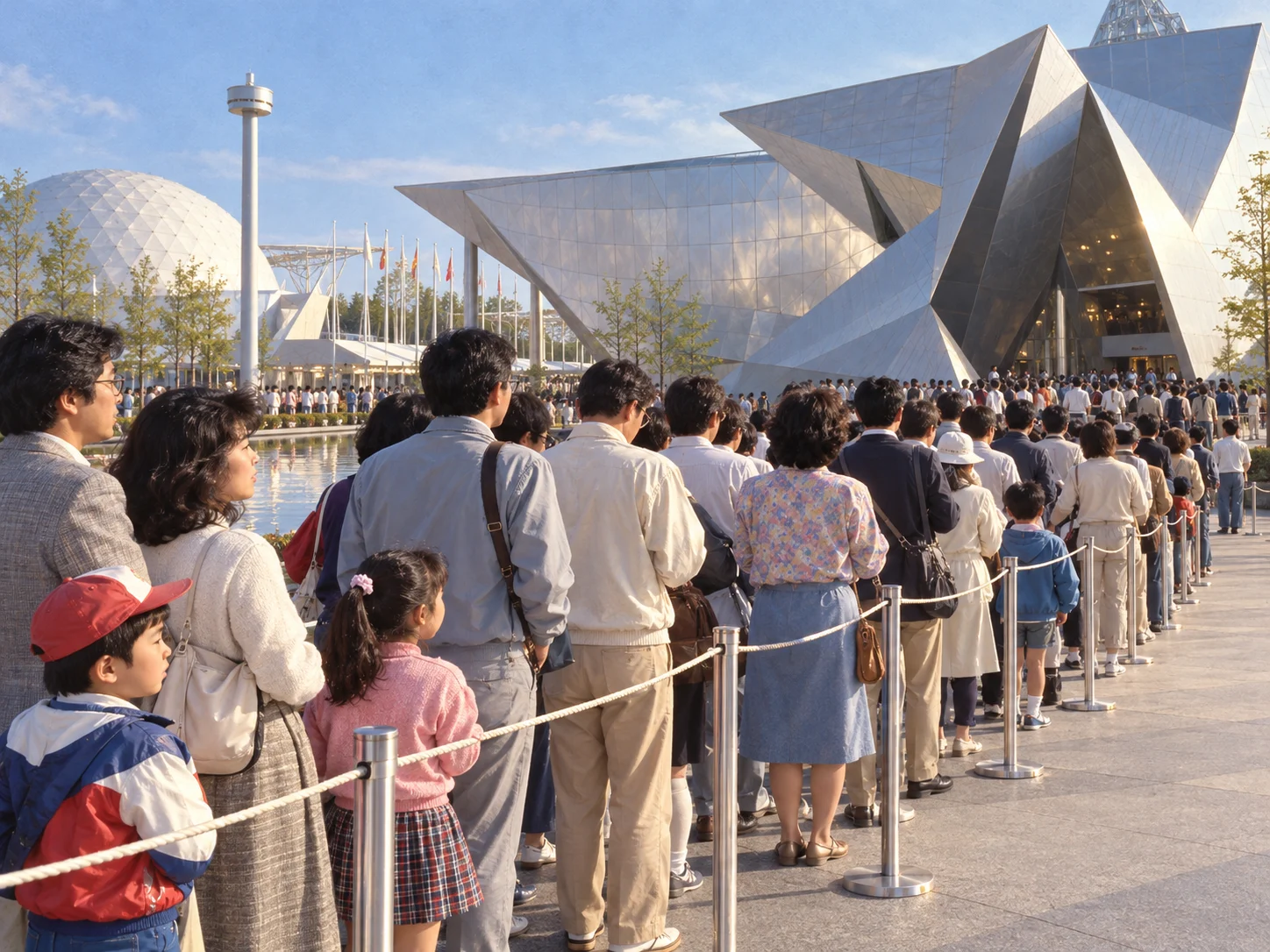
At Expo '85 in Tsukuba, long lines formed outside the most popular pavilions. A contemporary newspaper account reported that, one month after opening, ten pavilions had waits of more than three hours. A retrospective published by Ibaraki Prefecture also records long queues at attractions including the Sumitomo and Fujitsu pavilions.
Visitors were waiting for the twenty-first century as imagined through computer images, robots and communications technology. Innovations that can now be shared instantly on a screen were then enclosed inside particular buildings. When there was only one entrance to the future, curiosity acquired a physical length of three hours.
Waiting time also became a measure of popularity and could attract still more visitors. A queue obstructed access to an exhibit while advertising that something inside was worth the delay. The delight of this line lies in the contradiction: an exposition devoted to technological efficiency generated one of the most familiar forms of human inefficiency.