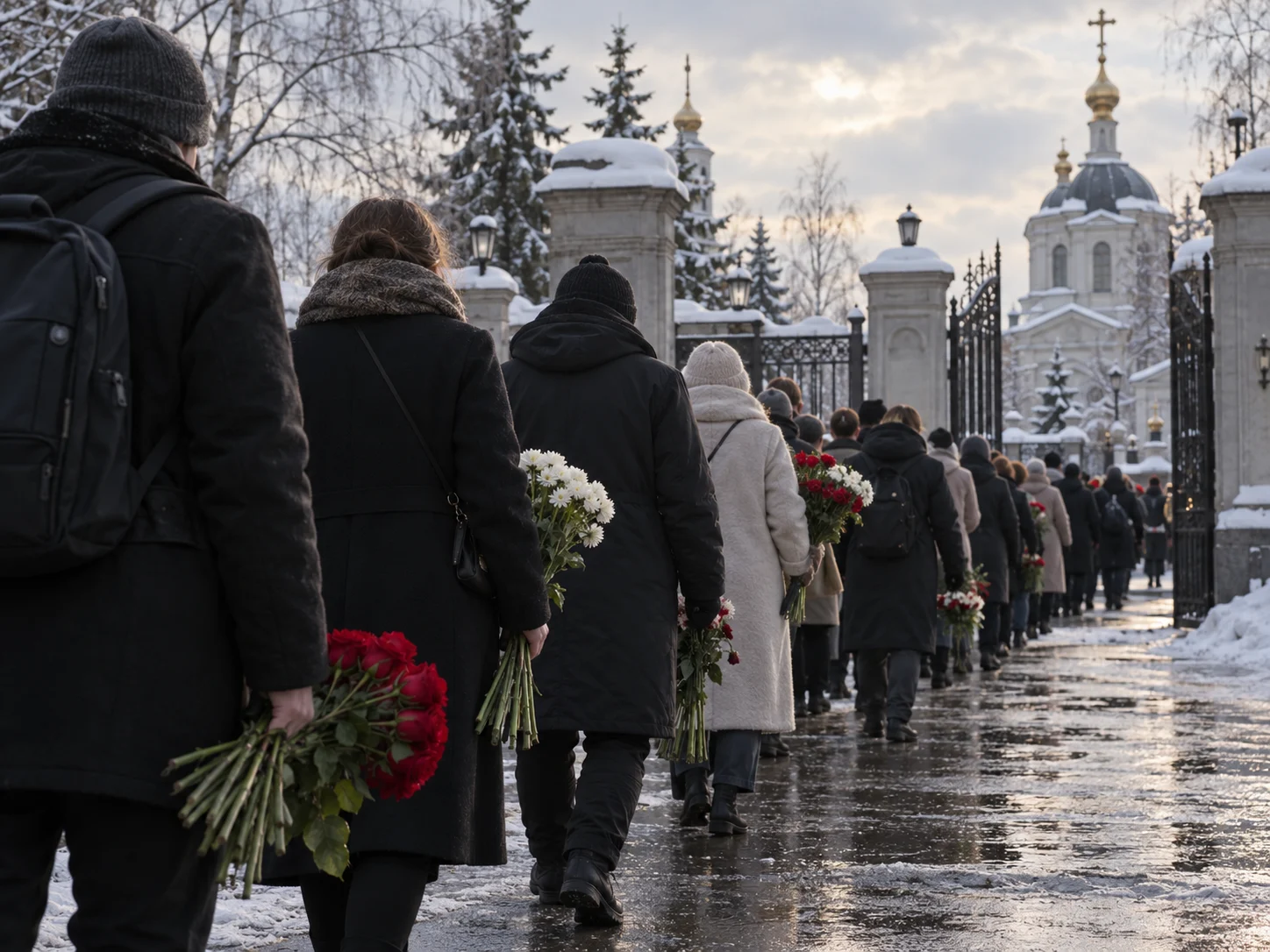
Alexei Navalny’s funeral was held at a church in south-eastern Moscow on 1 March 2024. The Associated Press reported thousands waiting outside and a stream of people continuing towards Borisovskoye Cemetery. The following day, Reuters directly described people queueing to place flowers on his grave. Mourning did not end with the service; it continued as individuals approached the burial place in turn.
This was not simply the congestion surrounding a famous person’s funeral. Navalny died in custody, and Russian authorities closely monitored public commemoration. AP also reported detentions connected with memorial actions elsewhere in the country. Standing in line was a practical way to reach the grave, but gathering openly carried political risk. That does not mean every participant had an identical motive, and the sources do not support inventing one.
The church entrance, the route to the cemetery and the grave itself narrowed the crowd into successive individual acts. Even where the state treated mass assembly with suspicion, mourning became visible as the order in which the next person stepped forward with flowers. The defining fact was not only the size of the crowd. It was that each participant accepted a public turn under observation.