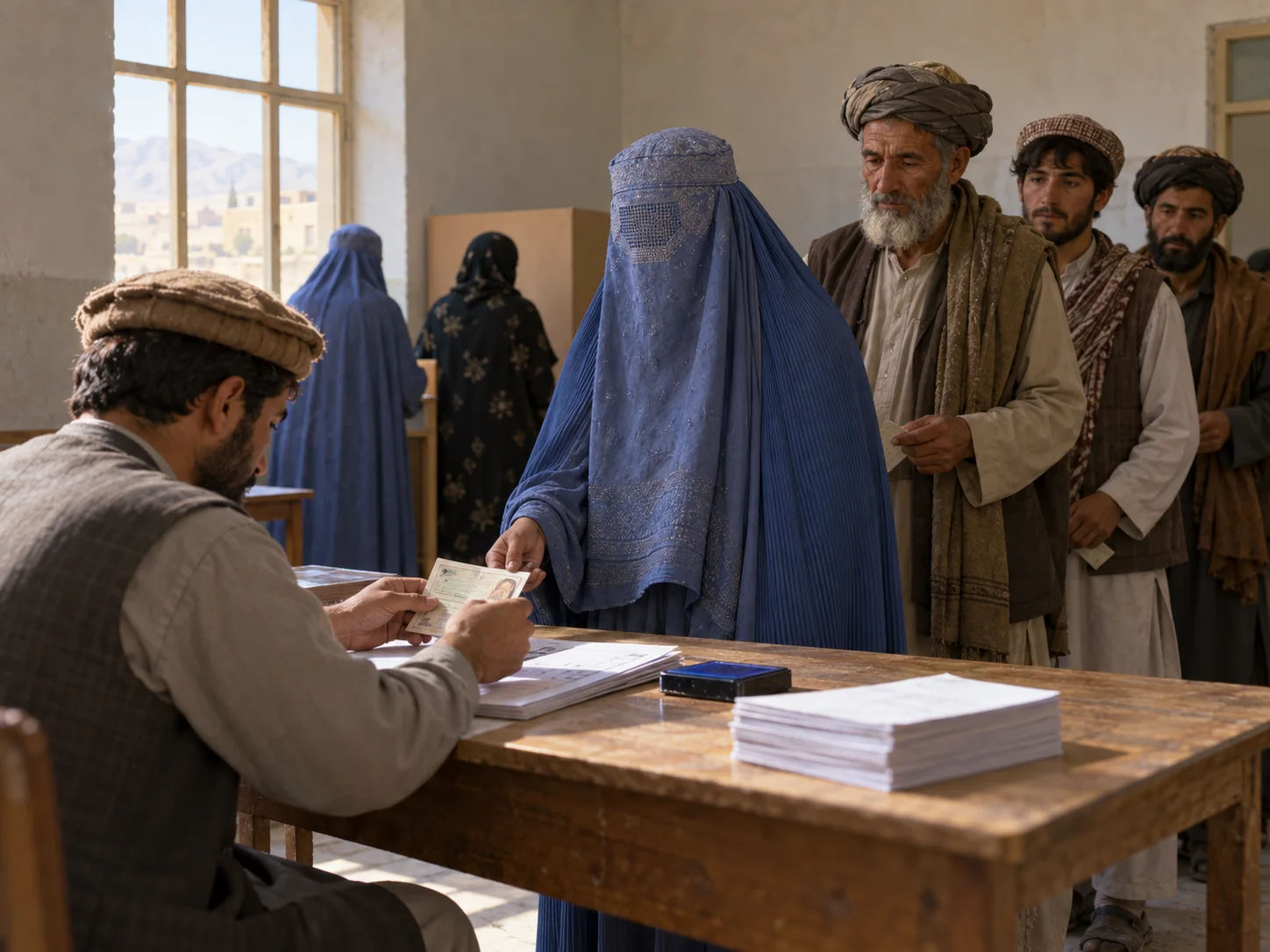
On 9 October 2004, voters waited outside a polling station in Kabul to enter and choose a president. A photograph preserved by the OSCE Office for Democratic Institutions and Human Rights identifies the scene precisely: Afghan voters waiting to enter a polling station in Kabul to vote for a new president. The same official gallery records voting, ballot counting and campaign posters, and notes that Afghanistan held its first presidential election that day.
After the fall of the Taliban government in 2001 and a period of interim administration, the election introduced a nationwide direct choice of head of state. Marking a ballot took little time, but access required registration, identity checks, secure premises, the transport of materials and arrangements for male and female voters. The photograph documents one location in Kabul. It cannot stand for every province or erase the very different risks faced elsewhere.
The election also faced a dispute over supposedly indelible ink, which briefly prompted rival candidates to call for a boycott. The existence of a queue is not proof that the entire process was fair or that every citizen could participate safely. What it does show is that a political right became a physical procedure at a particular entrance on a particular day. The OSCE image records people being admitted one by one. Afghanistan’s first presidential vote was not only a constitutional milestone; at ground level, it was a sequence of individuals waiting to cross a doorway and be processed as voters. The caption gives neither a headcount nor a waiting time, so neither is supplied here. Its value lies in showing a national election divided into the small, observable unit of admission through one Kabul doorway.