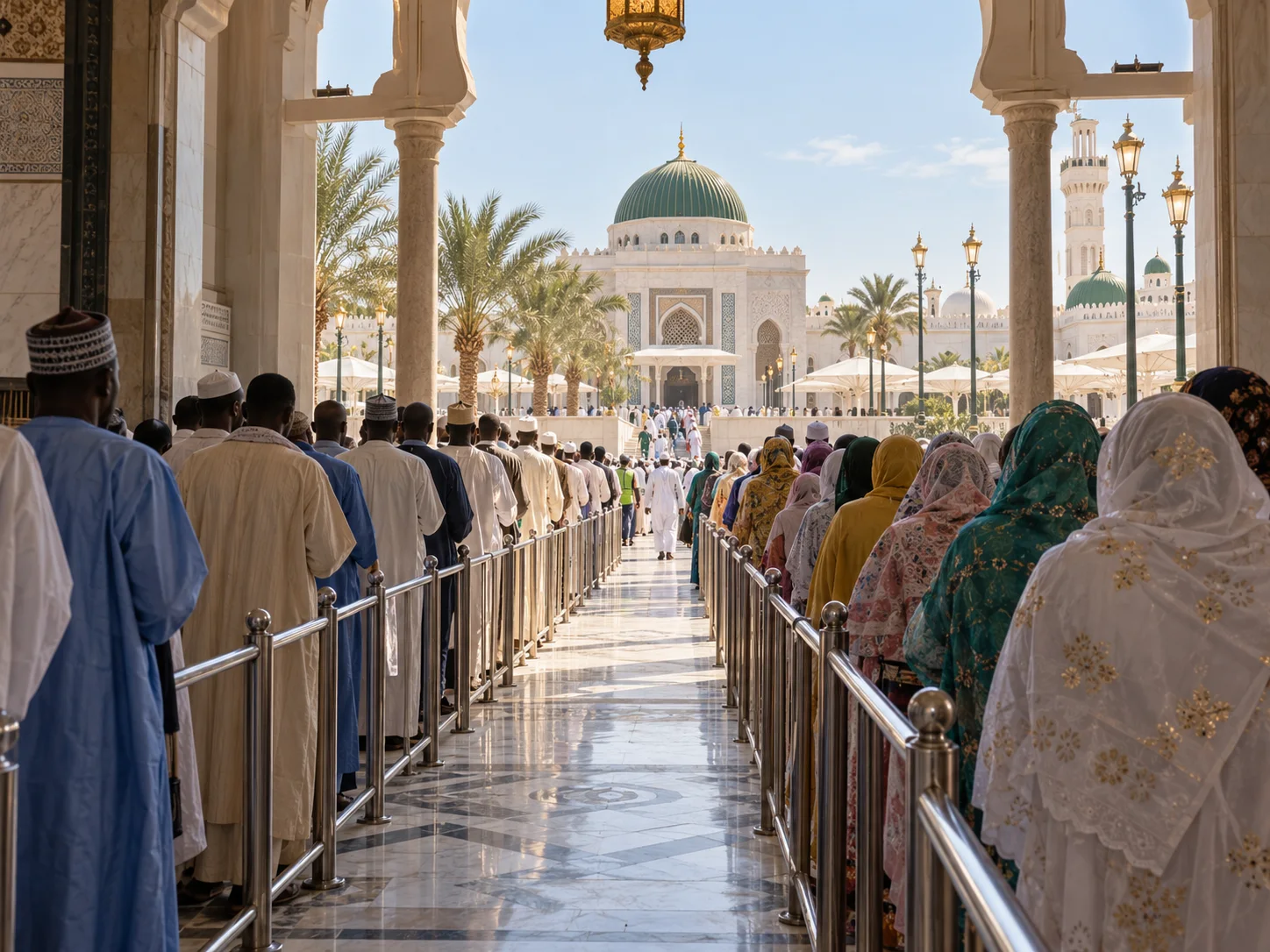
On 4 September 2025, pilgrims converged on Medina Baye in Kaolack, western Senegal, for the Mawlid, the celebration of the Prophet Muhammad's birth. The Senegalese Press Agency, APS, documented more than a crowd: thousands of people were queuing outside religious buildings, including the mausoleum of Sheikh Ibrahim Niass, founder of the Fayda Tijaniyya movement. Men and women formed separate parallel lines stretching for several dozen metres.
They were not waiting for tickets or a commodity. They were advancing toward the mausoleum complex to perform the zi'aar, a visit of prayer and remembrance. APS reported that the lines moved slowly as pilgrims sang religious chants. Worshippers had travelled from across Senegal and from other West African countries, giving the annual observance a regional dimension.
What distinguishes this queue is the way order becomes part of devotion. The two lines did more than manage a very large gathering. They turned a mass pilgrimage into a sequence of individual approaches to a sacred place, with each person waiting for a turn to enter the space of prayer.