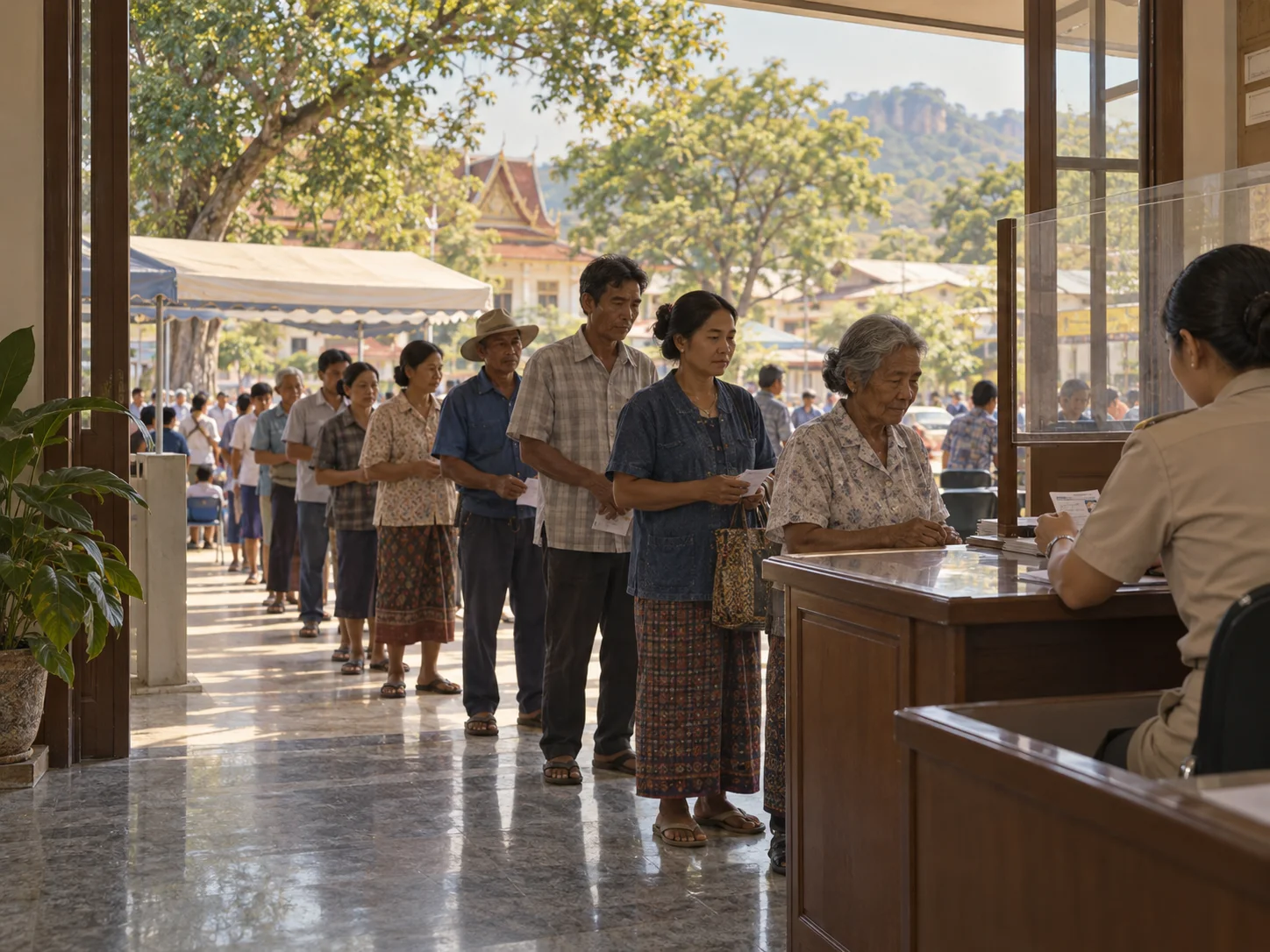
On the morning of 26 May 2026, shoes stood in line outside a Krungthai Bank branch in Dan Khun Thot district, Nakhon Ratchasima province, northeastern Thailand. Their owners were not necessarily standing inside them. Some people had set down shoes, water bottles and even small baskets to mark their places, then moved aside to sit in the shade, eat and drink while waiting for the bank to begin admitting customers.
According to the Thai newspaper Thairath, it was the second day of registration and identity checks for a government assistance programme called Thai Chuai Thai Plus. The problems bringing people to the branch were often decidedly ordinary: personal details requiring correction, a changed telephone number, a lost SIM card, or forgotten credentials for the Paotang app. Some older applicants were uncomfortable with the online process. People had arrived as early as 4 a.m.; the bank began issuing access to the queue at 7:30. A shoe could reserve a spot, but it could not shorten the morning.
The arrangement also exposed the fragile politics of an improvised queue. A shoe might be picked up because its owner needed to wear it, leaving a gap that another person could claim. Arguments broke out over the order. One 75-year-old woman described arriving with family at four without having eaten breakfast and finding the application process difficult. When the doors opened, the crowd pressed towards a side entrance. Staff eventually admitted people in groups of five.
It is tempting to see the line of shoes as a charming local trick. The more revealing detail is how much collective agreement that trick demanded. An object cannot testify to its owner's place; other people must recognise it. And the larger paradox lay beyond the footwear. A service designed to be accessed digitally still required some people to travel to a bank before sunrise. The shoes were not merely placeholders. They marked the distance between a system as designed and a morning as lived.
Where shoes held places, people could move into shade while arrival order remained visible on the ground. Familiar footwear became a queue ticket that neighbours could connect to its owner.