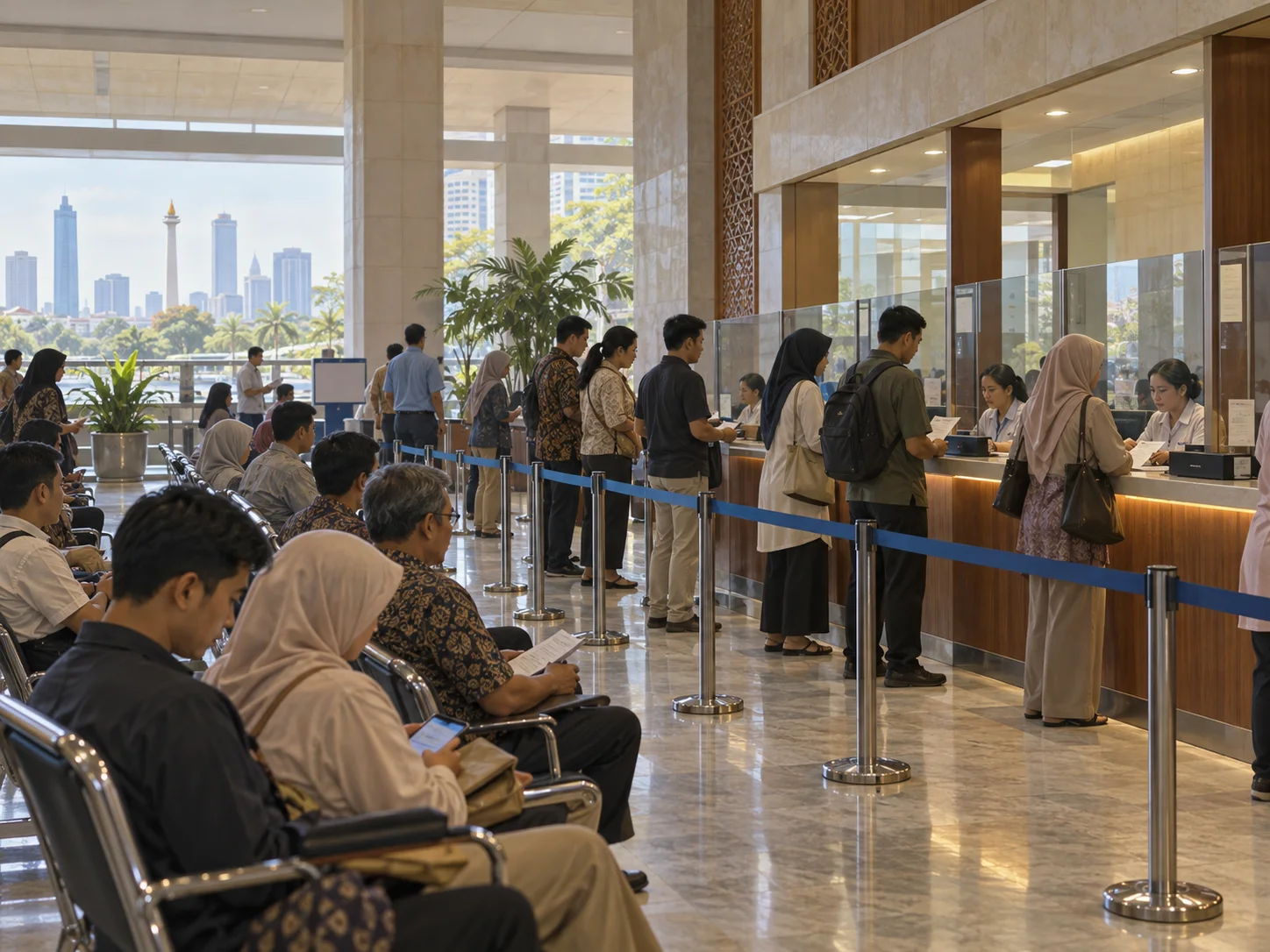
In Greater Jakarta, waiting in line at a hospital, public office, popular restaurant or concert-ticket exchange has become work that can be ordered through an app. DetikX reported in April 2026 on Antriin.id, a service that matches customers with nearby partners who physically hold a place for them. A customer specifies the kind of queue, location and duration, then follows progress through a chat function. The reported starting rate was 30,000 rupiah per hour for a hospital queue and 40,000 for other settings. About 200 partners were available across the metropolitan area.
The founder said he had observed queues at public services, health facilities and fashionable food venues before developing flexible procedures for different sites. If an order called for two hours at a particular hospital, the partner was expected to remain in that line for those two hours. The platform reduced a partner’s payment for arriving more than fifteen minutes late and charged customers when the requested period overran. Waiting time had become an explicit unit of labour, priced and monitored by software. One customer said she had twice used the service for family restaurant visits and avoided the exhaustion of queueing herself.
Whether a place can legitimately be transferred depends on the rules of each institution, a limit that no app can erase. Even so, the service reveals something distinctive about urban waiting: a queue can develop its own labour market. Antriin.id does not sell privileged admission. It sells the substitution of one person’s time for another’s. The line remains exactly where it was; what changes is whose body occupies the place.