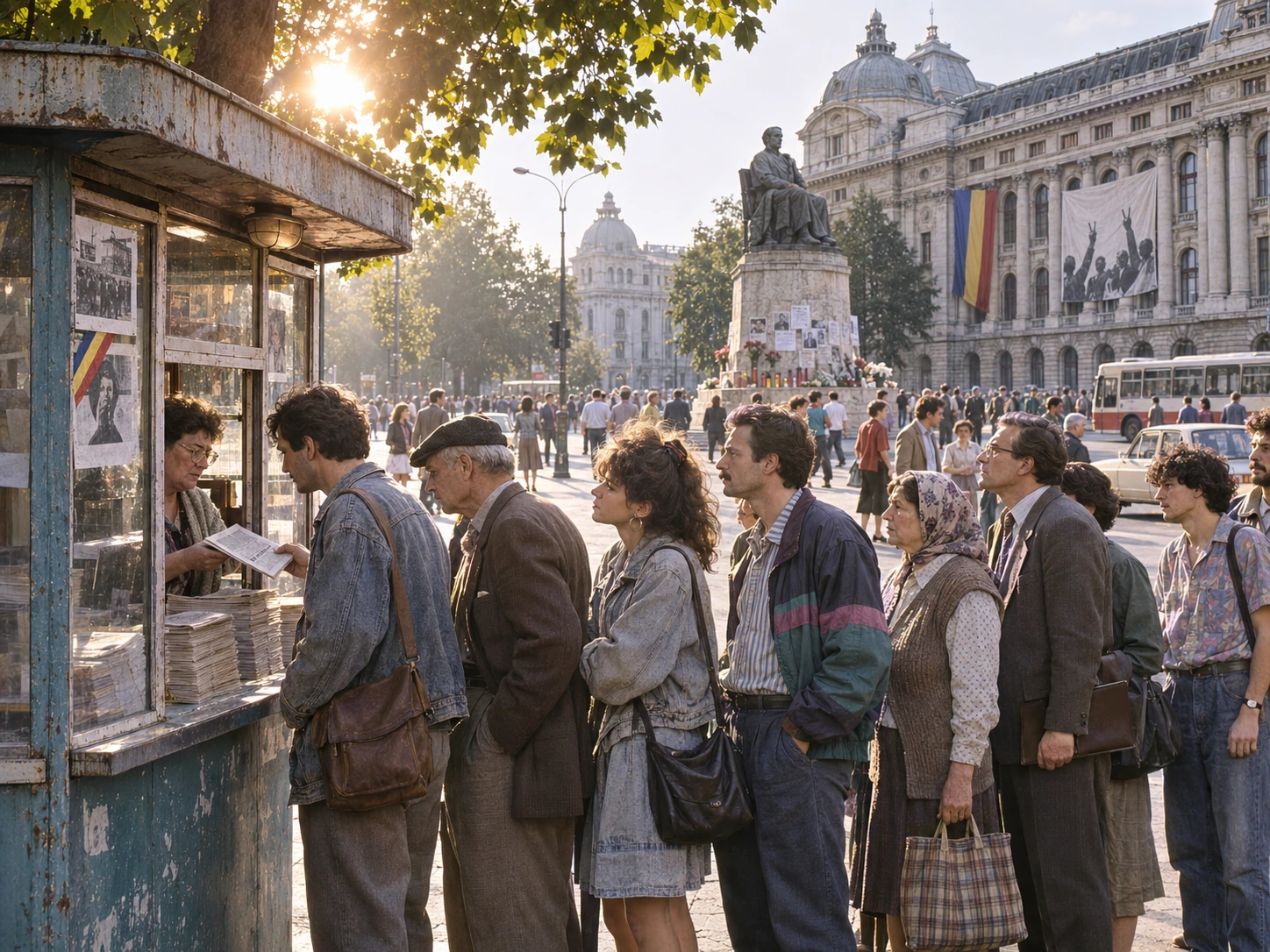
On the morning of 20 June 1990, people on their way to work in Bucharest formed lines to buy newspapers. A contemporary Washington Post account written near University Square recorded the scene only days after miners and others had violently suppressed an anti-government protest. Even amid that tension, the city’s morning began with an ordered wait for the press. What readers sought was not paper alone, but information with which to interpret politics after the revolution.
Following the December 1989 revolution, newspapers associated with the communist system changed names and editorial identities. Scînteia became Adevărul, meaning “The Truth,” while Scînteia Tineretului became Tineretul Liber, or “Free Youth.” A University of Bucharest history of the 1990 press reports that by June, Adevărul and România Liberă were each printing about 1.5 million copies a day. After decades of controlled language, demand for competing accounts helped sustain the daily lines.
The queue also showed that freedom of information did not arrive complete when the dictatorship fell. Protest continued in University Square, while newspapers and journalists remained exposed to political violence. Readers used time before work to obtain a copy before it sold out. Their place in line was an entrance to making their own judgment about a society changing faster than any single headline could explain.