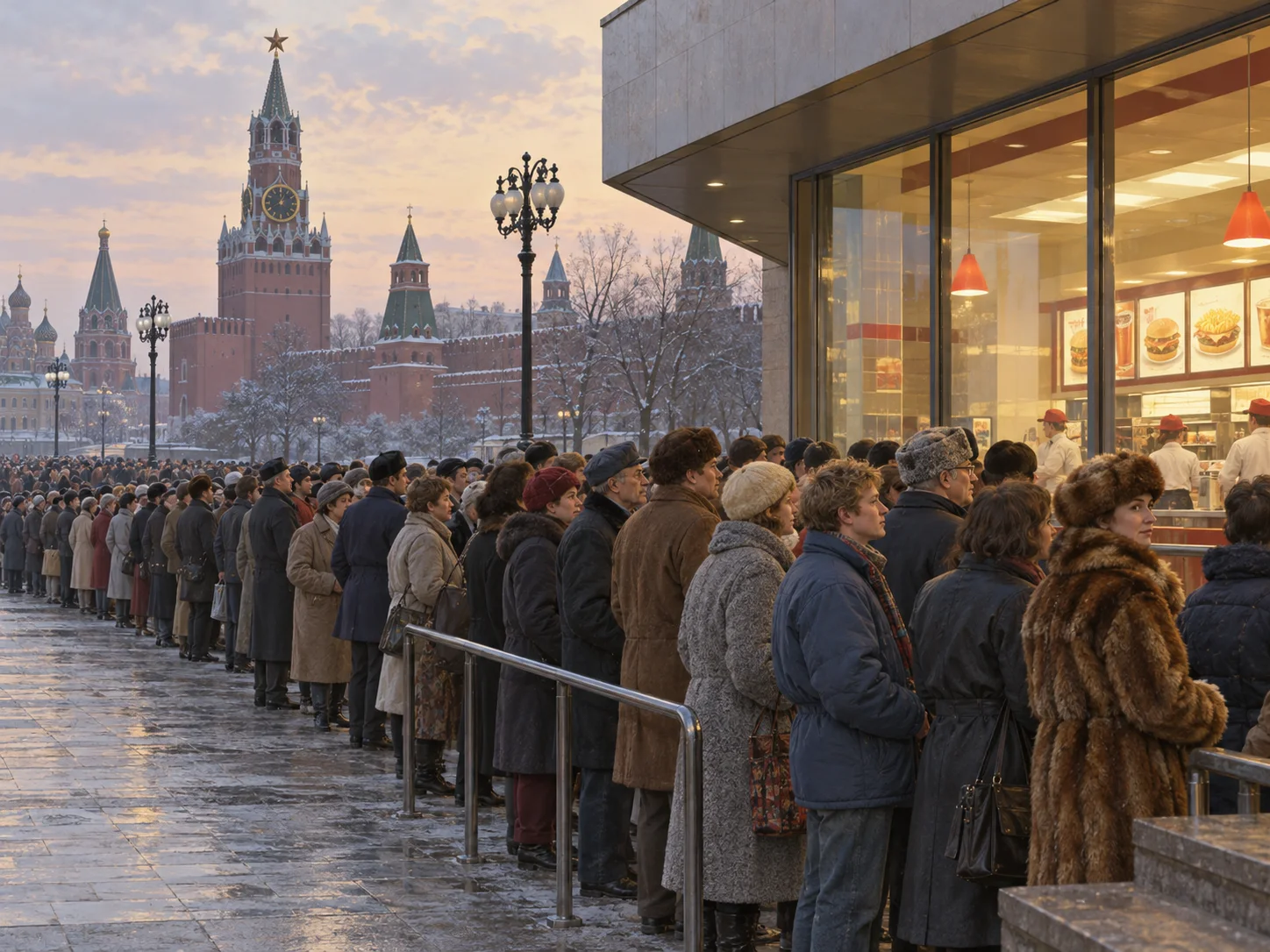
Before dawn on 31 January 1990, people began lining up near Pushkin Square in Moscow. The destination was not a government office or a food distribution point. It was the Soviet Union’s first McDonald’s. Wrapped in winter coats and hats, customers waited to order hamburgers in a restaurant unlike most they had previously encountered. An Associated Press report said the 700-seat store had 27 cash registers and sold about 30,000 meals on opening day. Demand kept the doors open two hours beyond the scheduled closing time.
It is easy to reduce this scene to a slogan about Soviet fascination with America. The queue deserves something more precise. This was the late Cold War, amid perestroika and rapid political change. A visit might have promised an unfamiliar taste, a different style of customer service, curiosity about a foreign business, or simply a memorable outing. The available reporting cannot assign the same motive to everyone in the line. Its meaning was larger than a single burger, but it was not necessarily identical for every customer.
There is an important reversal here. Long lines were already familiar in a society where obtaining everyday goods could require patient waiting. The novelty lay at the front of this particular line. Instead of queuing because an ordinary item was in short supply, customers were waiting for the chance to try a new kind of choice. That did not make the meal affordable to everyone, nor did it turn a complicated society into a simple story of cheerful consumption.
The Soviet Union still existed on that January morning. Customers could not know precisely how soon it would disappear, or how Russian life would change afterward. Yet, for a few hours, a line for lunch brought together two clocks: the slow clock of everyday waiting and the fast clock of history. A turning point need not arrive as a speech or a treaty. Sometimes it looks like a cashier calling the next customer.
Inside the Moscow restaurant, a large staff had to turn novelty into a functioning service. The queue tested ordering, cooking and collection as much as appetite. The opening imported not only a meal, but a system designed to move customers rapidly.
On opening day, 31 January 1990, the Pushkin Square restaurant served about 30,000 customers in one of the chain’s largest dining rooms. The wait was for more than a hamburger: visitors were encountering a western system that sold speed, standardisation and service as part of the meal.