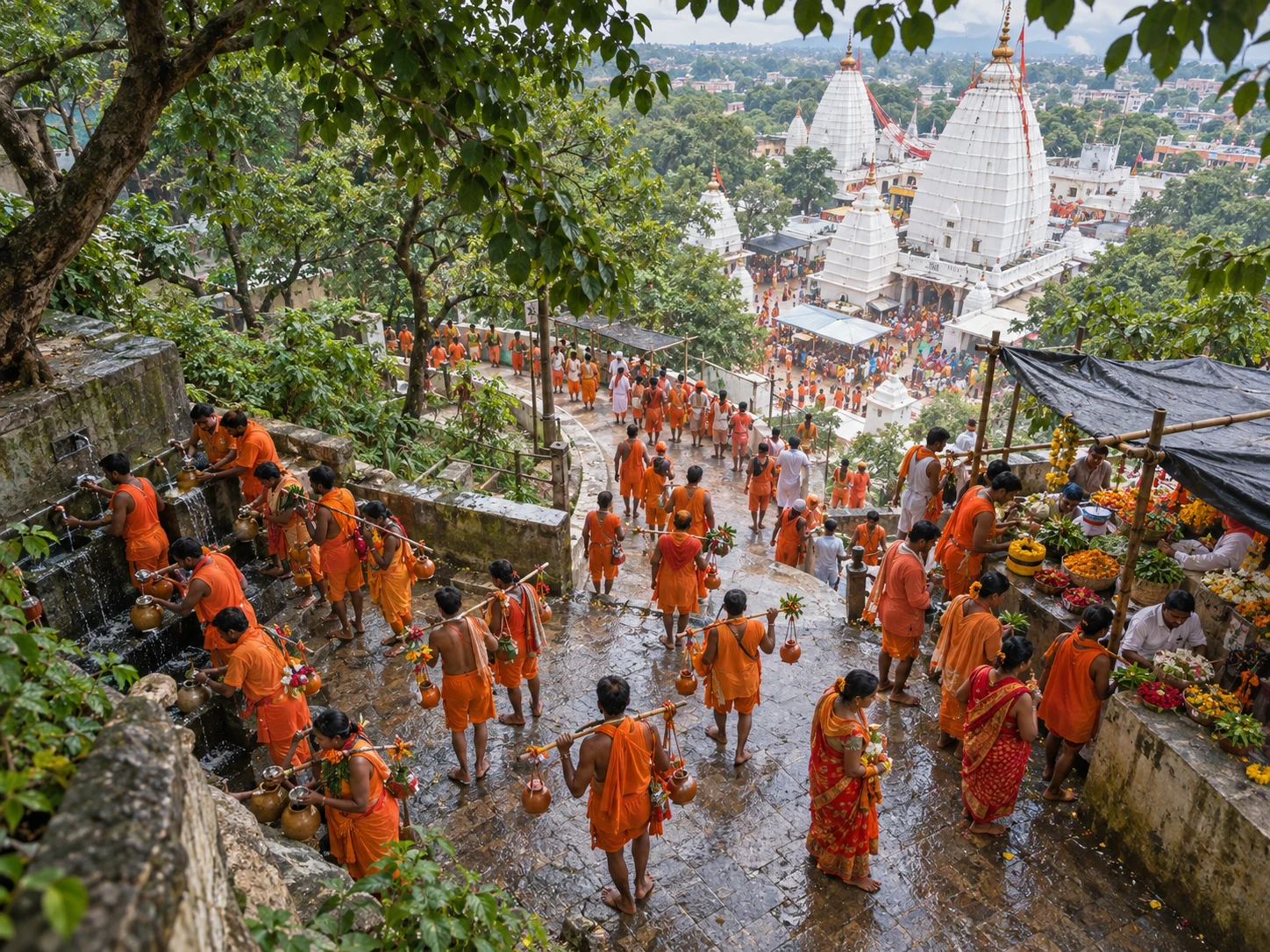
On the first Monday of the month of Shravan in 2003, the doors of the Baidyanath Shiva temple in Deoghar, in India’s Jharkhand state, opened at 3:15 a.m. By then, the queue of worshippers was reported to extend for about eight kilometres. Pilgrims dressed in orange waited to offer water carried from the Ganges to the Shiva lingam.
The length of the line cannot be explained by popularity alone. A ritual requiring people to carry water, arrive on an auspicious day and approach a single sacred object transformed a vast pilgrimage into a narrow sequence of turns. Contemporary reporting also described hundreds of thousands of pilgrims converging on the town.
The eight-kilometre figure is striking because it did not measure ordinary traffic. Each pilgrim’s vessel of water, transported from afar, was ultimately directed toward the same lingam. Access to that one point produced a line reaching far beyond the temple itself.
Quality check: Hinduism Today’s 2003 account directly connects Deoghar, opening time, an eight-kilometre pilgrim queue, and the offering of Ganges water.