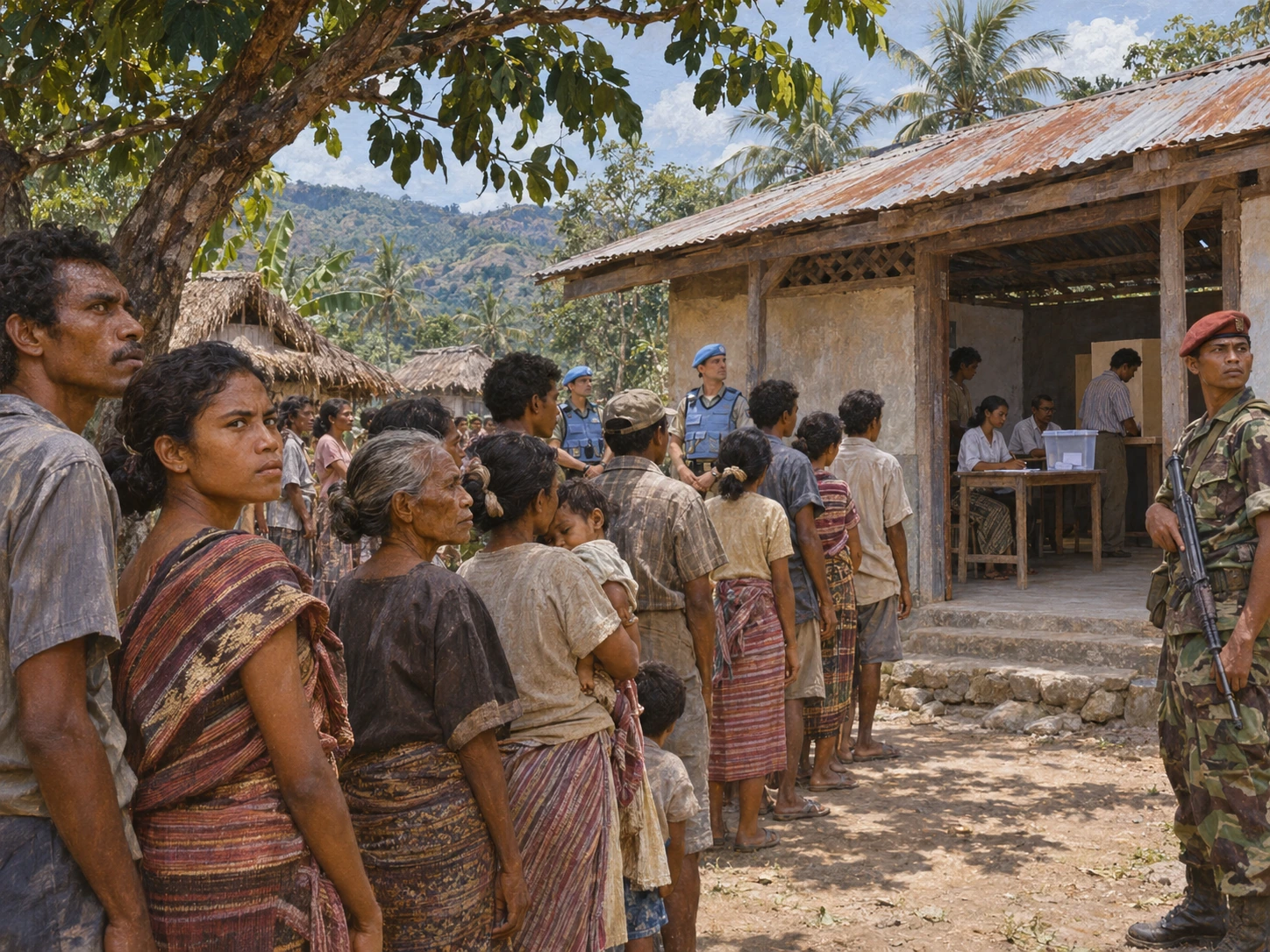
On 30 August 1999, East Timorese voters went to polling stations to decide their territory’s political future. The UN-organized popular consultation asked whether they accepted a proposal for special autonomy within Indonesia. A rejection would set the territory on a path toward independence. According to election records preserved by Georgetown University, when electoral staff arrived at polling centres at 4 a.m., voters were already waiting. Polling was scheduled to begin at 6:30. The queues preceded the official start of the day.
Contemporary reporting from Dili described voters carrying registration papers, standing in the heat, and a line at one station stretching far enough to block the road. Older voters arrived with relatives. This was not the comfortable anticipation of a concert or a sale. Violence and intimidation had shadowed the campaign; merely appearing to vote could carry fear. A photograph of a crowded polling place cannot tell us what each individual felt, and a large turnout should not erase the danger surrounding it.
UN records give the registered electorate as 451,792. With turnout exceptionally high, 344,580 votes—78.5 percent of valid votes—rejected the autonomy proposal. Violence and displacement followed the announcement of the result. The courage required to cast a ballot did not immediately bring security, and independence would not be formally achieved until 2002.
A queue at a polling place is often offered as a reassuring image of democracy. This one asks for a more demanding reading. The person ahead might have wanted a different future; the person behind might have been carrying the same fears. All entered through the same procedural doorway, but their choices were private. On that August morning, the ordinary act of waiting for one’s turn helped make possible a collective decision that had long been out of reach.
The line before dawn was waiting for more than the opening of a polling station. It was the first sequence in which East Timorese could help decide a future long determined by others.
Those who reached East Timor’s polling places before dawn were not choosing an ordinary slate of candidates. They were waiting to answer a question about the territory’s political future. The line did not determine the result, but it made visible how many people invested their own time in the chance to vote.