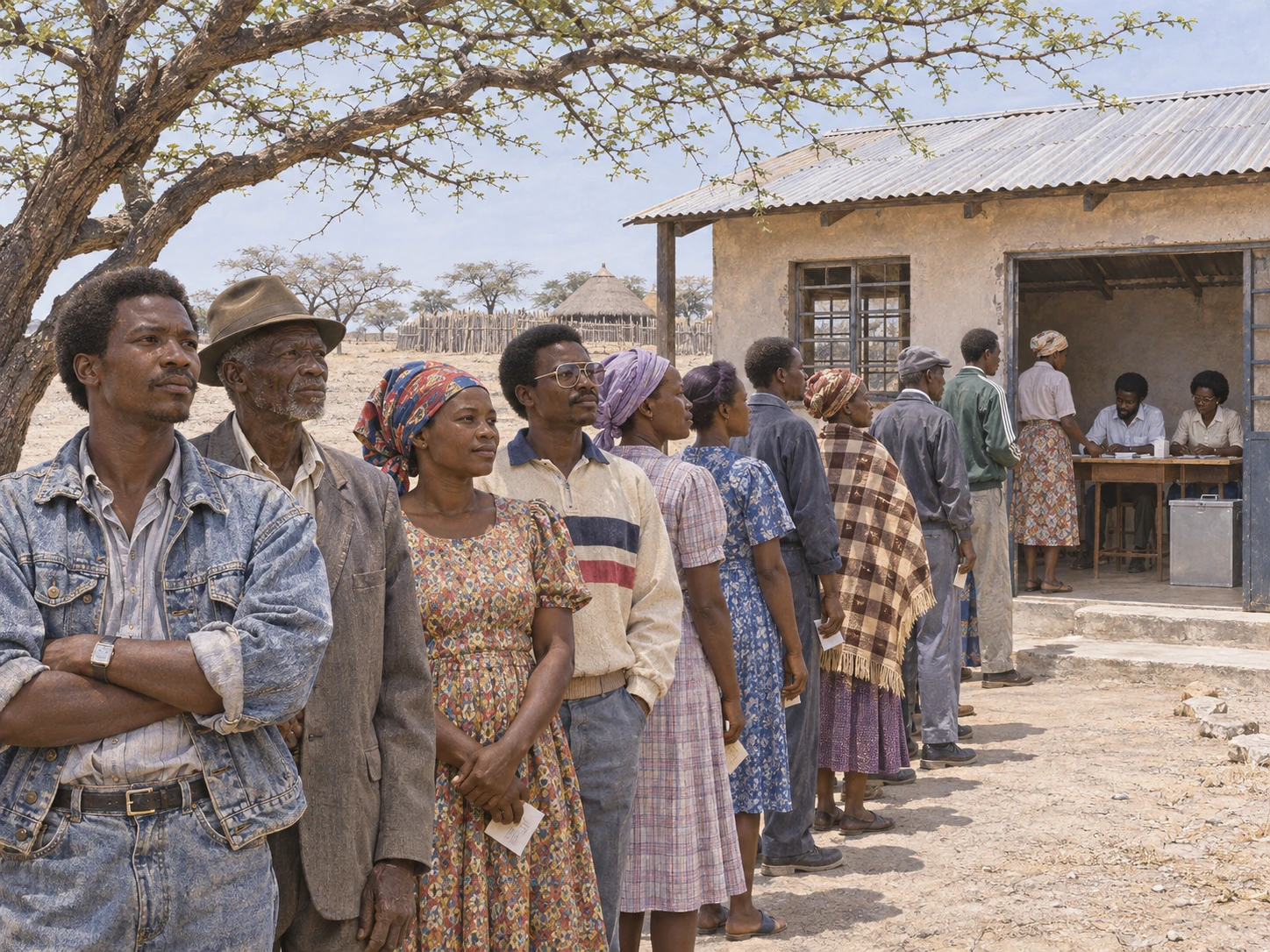
A photograph held by the Australian War Memorial offers a way to approach elections and the era of independence without reducing them to dates in a textbook. People waiting to vote turn an enormous political event into a series of ordinary acts: reaching a polling place, finding the correct entrance, standing in turn and finally casting a ballot. A constitutional change may occupy one line in a chronology. Participation occupies real time in a person's day.
The image also sets limits on what can responsibly be said. A parasol does not tell us how long its owner waited or what the weather felt like. A visible line does not establish that everyone nearby had the same voting rights. The archive's caption must be checked for the date, place and election; separate historical records are needed to explain who was eligible to vote. Photographs are powerful precisely because they are specific, not because they can stand in for every experience of an era.
Voting queues are often used as shorthand for democracy. Yet the shorthand can conceal the people it is meant to celebrate. Who could reach the polling station? Who was excluded? Who could afford the time required to participate? Rather than pretending the image answers every question, this atlas treats it as a starting point for asking better ones.
A long queue on the eve of independence cannot be read as unanimous support for one outcome. What the image establishes is that people with different choices entered the same voting procedure in sequence.