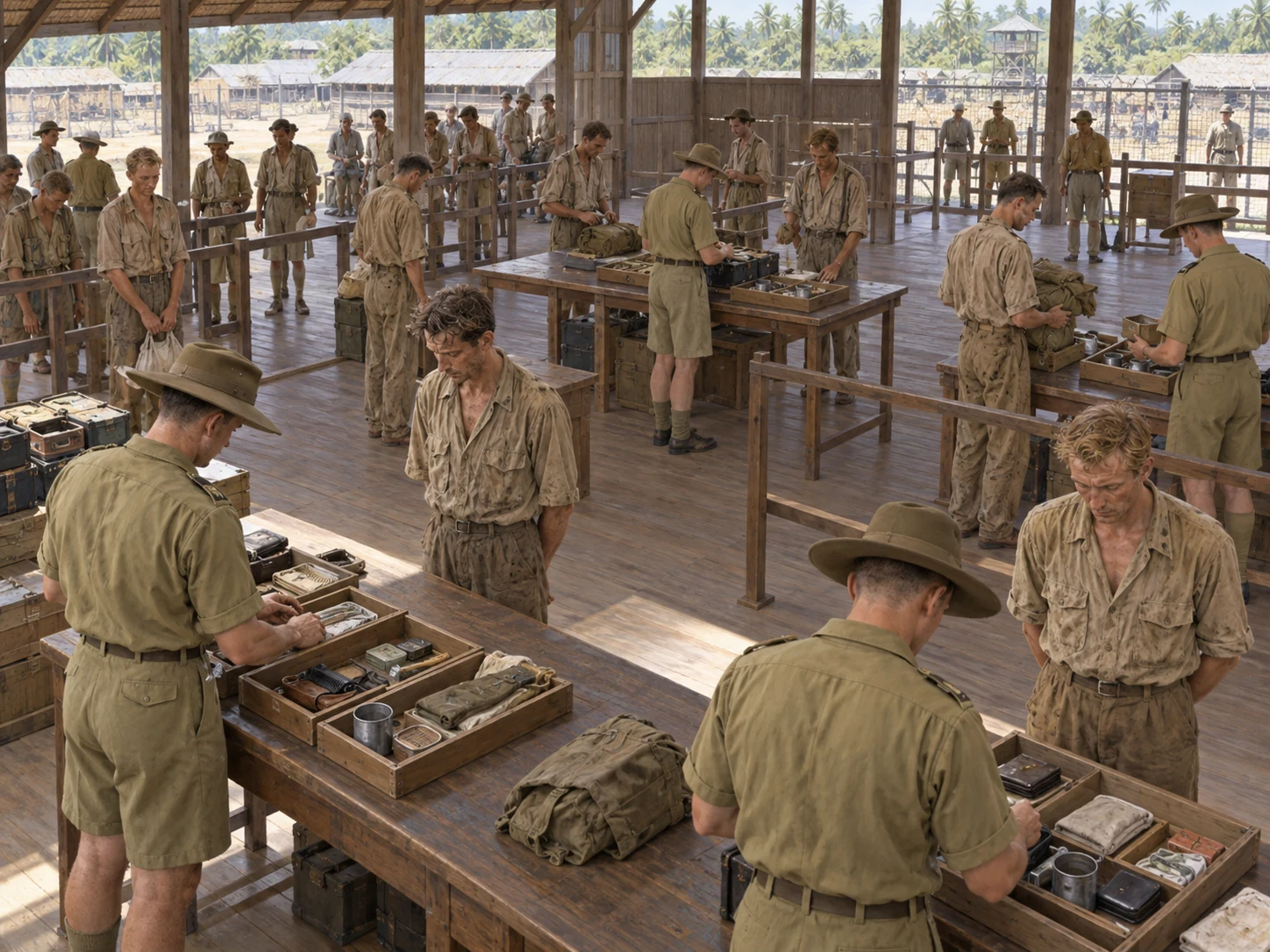
On October 8, 1945, Japanese troops from Colonel Iemura's force waited in a search queue at Jesselton in North Borneo. According to the Australian War Memorial's caption, they were disarmed, searched, medically examined, and marched under guard of the 2/32nd Battalion into a prisoner-of-war compound. The photographer was Sergeant F. A. C. Burke.
This was not a voluntary line for a service. It was an imposed sequence in captivity, created so that those in control could inspect bodies and possessions one person at a time. The catalogue describes the prisoners as fit and says they were used to build additional compounds for other Japanese personnel. That administrative wording does not reveal each prisoner's condition or feelings, and this article does not invent them.
Queues can share the same visible form while representing very different relations of power. Waiting by choice and waiting under orders must not be treated as equivalent. The order in this photograph was not a clever convenience for customers; it was one stage in a system of disarmament, examination, confinement, and labour. The apparent neatness of the line should never be mistaken for the consent of the people made to stand in it.