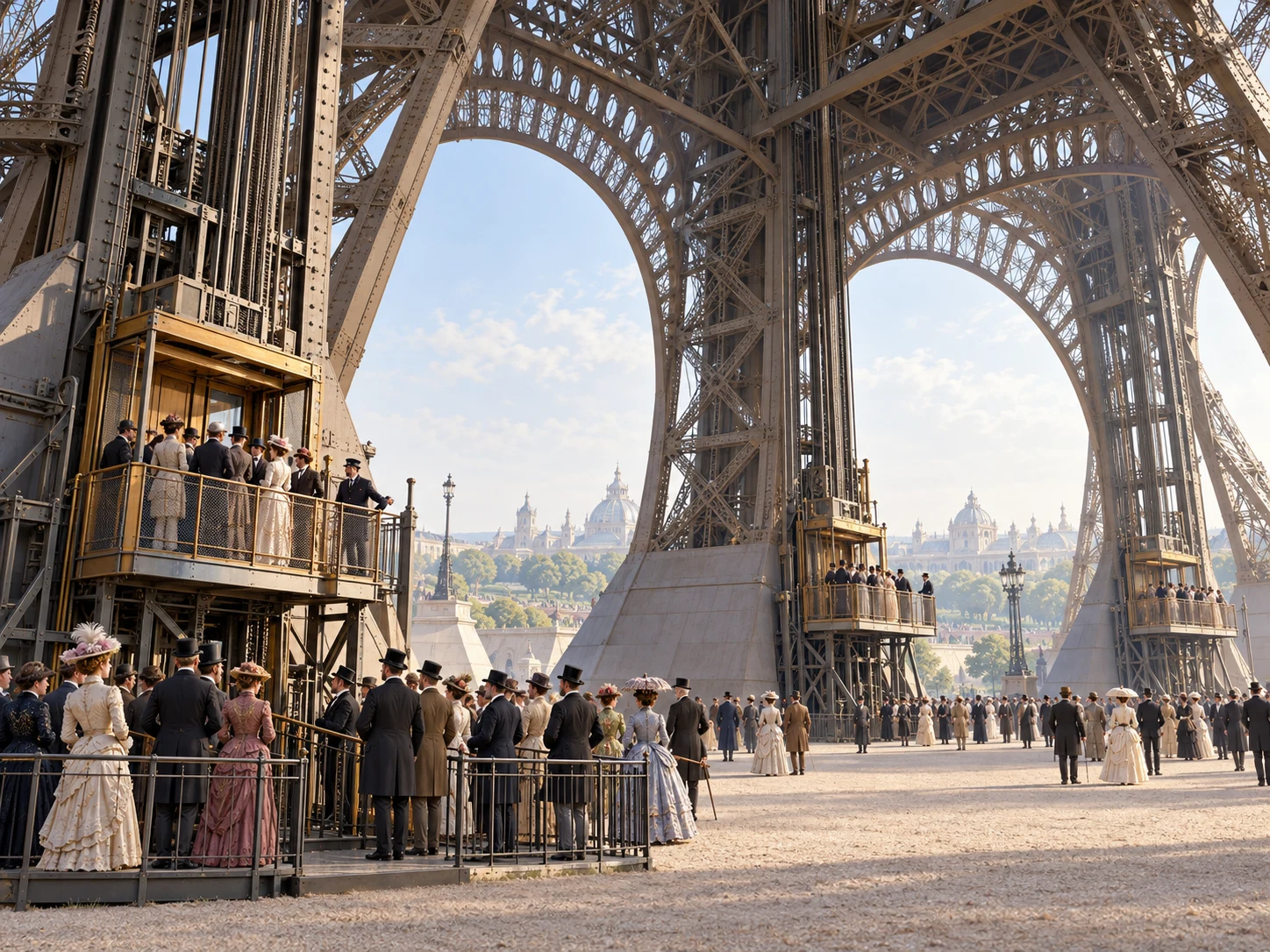
When the Eiffel Tower opened to the public during the 1889 Paris Exposition, its lifts were not yet operating. The tower's official history says that almost 30,000 people climbed 1,710 steps during the first week; the lifts entered service on 26 May. Nearly two million visitors ascended during the fair. Those waiting at the base were not passive customers being carried through a finished attraction. They were testing the new iron structure with their own legs.
The tower displayed engineering ambition at a height of 300 metres, but admission remained governed by capacity. Visitors bought tickets, entered through a leg of the structure, and moved to stairs or lifts. Even after lift service began, machinery following the curved legs could carry only a limited number at a time. Greater technical novelty therefore made orderly intake more, not less, important.
Dividing thirty thousand by seven days cannot capture the experience. Visitors were queueing for a method of ascent as much as for the panorama. The entrance to a futuristic view over Paris remained an old-fashioned arrangement on the ground: tickets, turns and time.
The first visitors did not yet have the option of waiting for an easier ascent. Physical endurance was part of admission. After 26 May, machinery absorbed much of that effort but introduced another interval: waiting on the ground for a limited lift car to return. Technology did not abolish waiting; it exchanged labour on the stairs for a turn at the entrance.