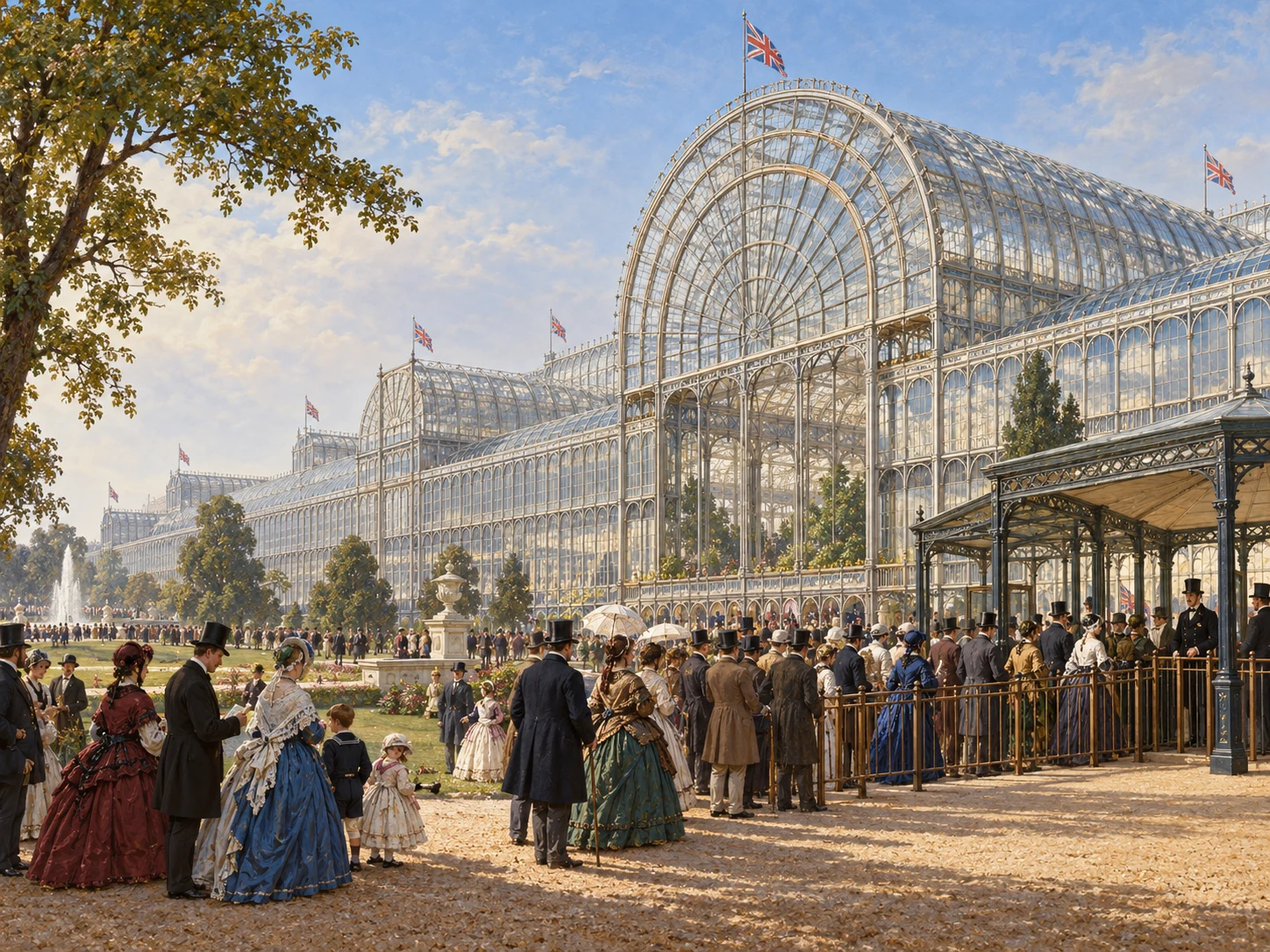
In 1851, visitors converged on the Crystal Palace in London's Hyde Park for the Great Exhibition. The iron-and-glass building assembled industrial products and art from many countries, combining a trade fair with mass tourism. A contemporary illustrated record held by the British Library shows dense but ordered crowds entering and circulating through the palace.
The organisers used dates, weekdays and ticket prices to shape attendance. After expensive days came cheaper admission that opened the exhibition to more working-class visitors. Price was therefore not only revenue; it was a device that changed how many people arrived. At the entrance, tickets were presented and inspected before visitors could move inside at the building's manageable pace.
The illustrations cannot establish each person's wait. They do show that before the glass roof could absorb a mass audience, a boundary had to convert individuals into admitted visitors. Concentrating the world's goods in one building also concentrated curiosity in one place. The grand display of international exchange began with a small action at a Hyde Park entrance: holding a ticket and waiting for one's turn.
More than six million visits were recorded over the season, and railways carried large crowds towards Hyde Park. Faster transport could deliver people quickly, but it did not widen the doors or interior routes. The mass mobility created by steam and railways was compressed at arrival into ticket-by-ticket admission, where modern speed returned to the width of one person.