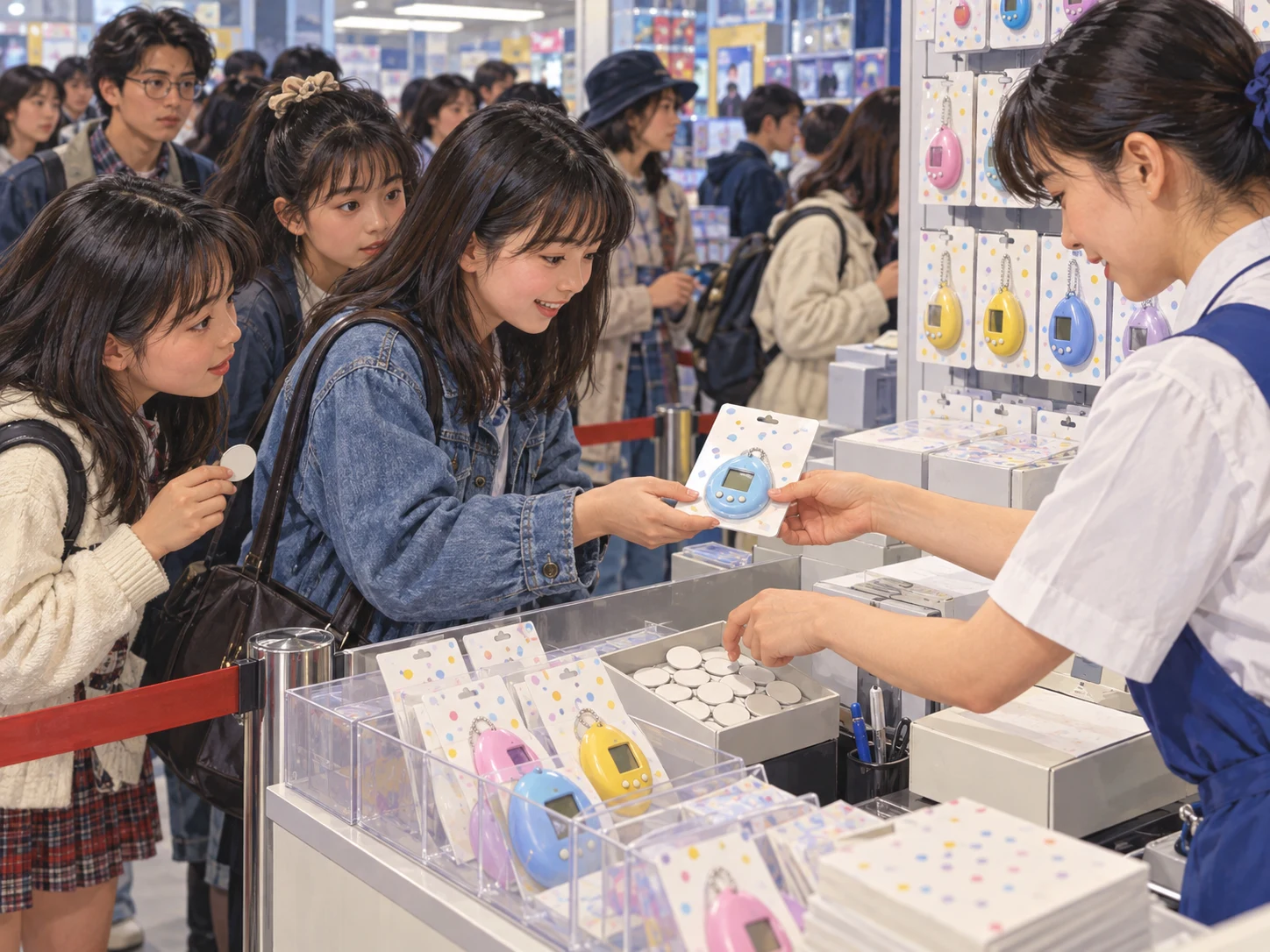
Tokyo, January 1997. At Hakuhinkan Toy Park in Ginza, people arrived on a Sunday carrying vouchers they had obtained after spending hours in line the day before. Their prize was Tamagotchi, a tiny egg-shaped electronic toy. An Associated Press report described hundreds returning with those vouchers. Buying the toy had become a two-day sequence: queue first for permission to buy, then come back to collect the thing itself.
Released in Japan on 23 November 1996, Tamagotchi put a needy digital creature on a key ring. Three buttons were enough to feed it, attend to its needs and influence how it grew. The appeal was not limited to children. The contemporary report described adults at the store, including a 27-year-old programmer who said he would be proud to bring the toy to work precisely because his colleagues did not yet have one. Possession conferred a small social advantage, even before anybody had learned to care for the pet.
A documented line at one store should not be turned into a claim that every shop in Japan looked the same. What makes the Hakuhinkan incident useful is its specificity: vouchers earned by waiting on Saturday, customers returning on Sunday, and a toy whose shortage changed how a shop allocated access. A later ITmedia account, citing Bandai, recalled lines reaching 2,000 to 3,000 people at some locations during the wider boom. That is a retrospective figure about the phenomenon, not a count of Sunday's customers at this particular store.
There is a satisfying absurdity to what people were waiting to own. The product did not promise to save its owner time. Once purchased, it demanded more: a creature that needed attention, food and care on its own schedule. First the humans waited for the egg; then the creature inside the egg waited for the humans. In 1997, a miniature screen made the oldest of social arrangements—someone waiting for someone else—feel entirely new.
Tamagotchi was designed to demand attention in the palm of a hand, yet at launch it was people who waited outside shops. Time spent raising a virtual creature began with a very physical queue to obtain one.