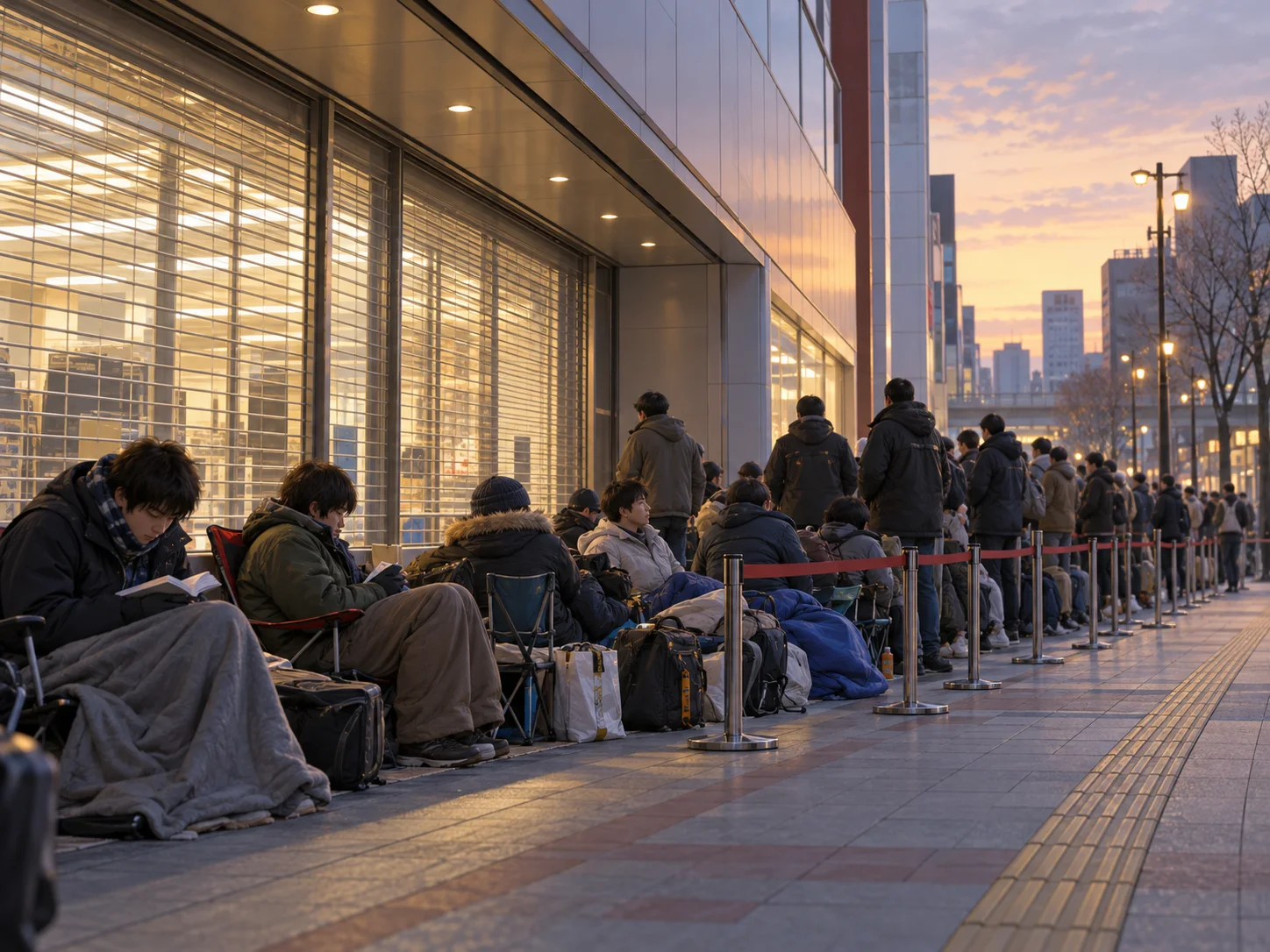
Nintendo launched the Wii in Japan on 2 December 2006. Before sales began at 7 a.m., about 2,000 people were waiting outside Bic Camera in Tokyo's Yurakucho district, and similar lines appeared at electronics retailers nationwide. Customers were not simply buying another machine in the race for sharper graphics. The Wii Remote, designed to be swung like a racket or sword, embodied Nintendo's attempt to bring families and less experienced players into console gaming.
A launch queue is created by distribution as much as desire. When a fixed stock reaches stores for sale at a fixed hour on a first-come basis, wanting a product becomes a competition over arrival time. The Yurakucho customers surrendered hours before they could acquire a device meant for leisure. The Wii's celebrated innovation was physical play, but its first mass physical performance in Japan did not take place in a living room. It occurred on a winter pavement, where two thousand bodies held their places until the shop doors opened.
Later market figures put Japanese sales at roughly 989,000 units by the end of December. The two thousand people in Yurakucho were not the whole market; first-day retail allocation concentrated one portion of demand in a single visible place. Before popularity appeared in sales tables, it was drawn on the pavement as spacing between bodies.