The official map for Comic Market 105 marks more than halls and railway stations. It identifies separate East and West/South waiting lines for Early Entry and AM Entry. Holders of AM wristbands may choose either side. QR-ticket exchange locations change after 12:30, and the map warns that visitors may need a detour depending on the location of the end of the waiting line. The tail of the queue is therefore not a fixed landmark. It is an operational element that moves with the crowd.
Comiket’s official guide for overseas visitors describes an event attracting about 200,000 participants per day. It tells visitors not to wait outside overnight and to arrive only after the first train. First-time attendees are advised to come around noon to avoid long lines, and people are warned not to leave belongings behind to hold a place. For Comic Market 97 in 2019, a smaller venue configuration brought a daily admission wristband, and the committee cautioned that lines to buy wristbands on site could be long.
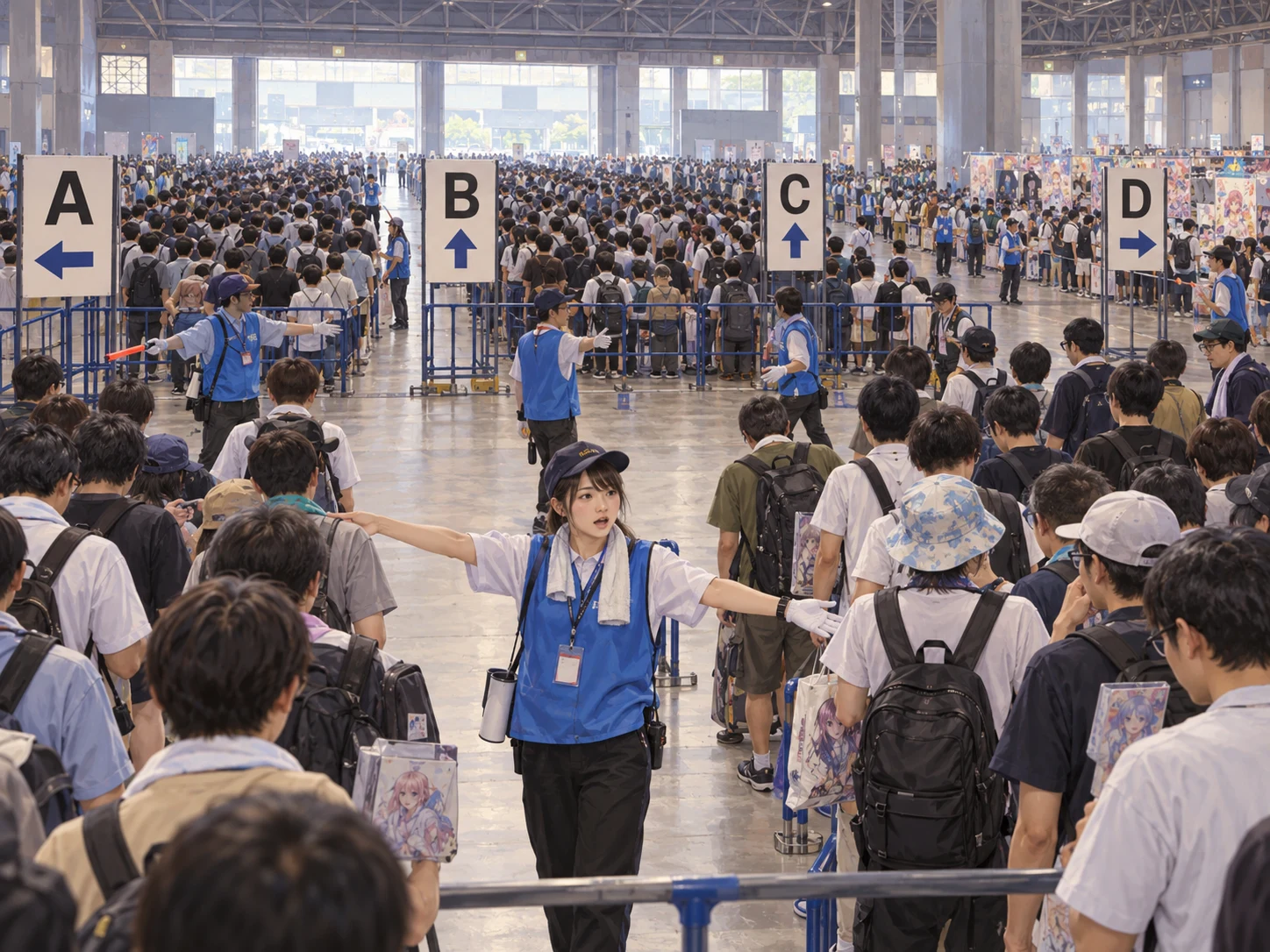
Managing a crowd of this scale does not mean placing everyone inside one enormous switchback. The system divides arrivals by time, admission entitlement and destination before they reach the doors. It assigns walking routes from different stations, separates ticket exchange from admission, and changes detours as the end of a line moves. Everyone may be waiting for the same event, but the map treats them as several flows. Comiket’s official diagrams reveal a queue not simply as a group of people but as a temporary transport system laid across part of the city. The first Comic Market in 1975 had 32 circles and about 700 participants. The official guide later described more than 30,000 circles and 500,000 people per session, making mapped queue control a condition of growth rather than a side effect.