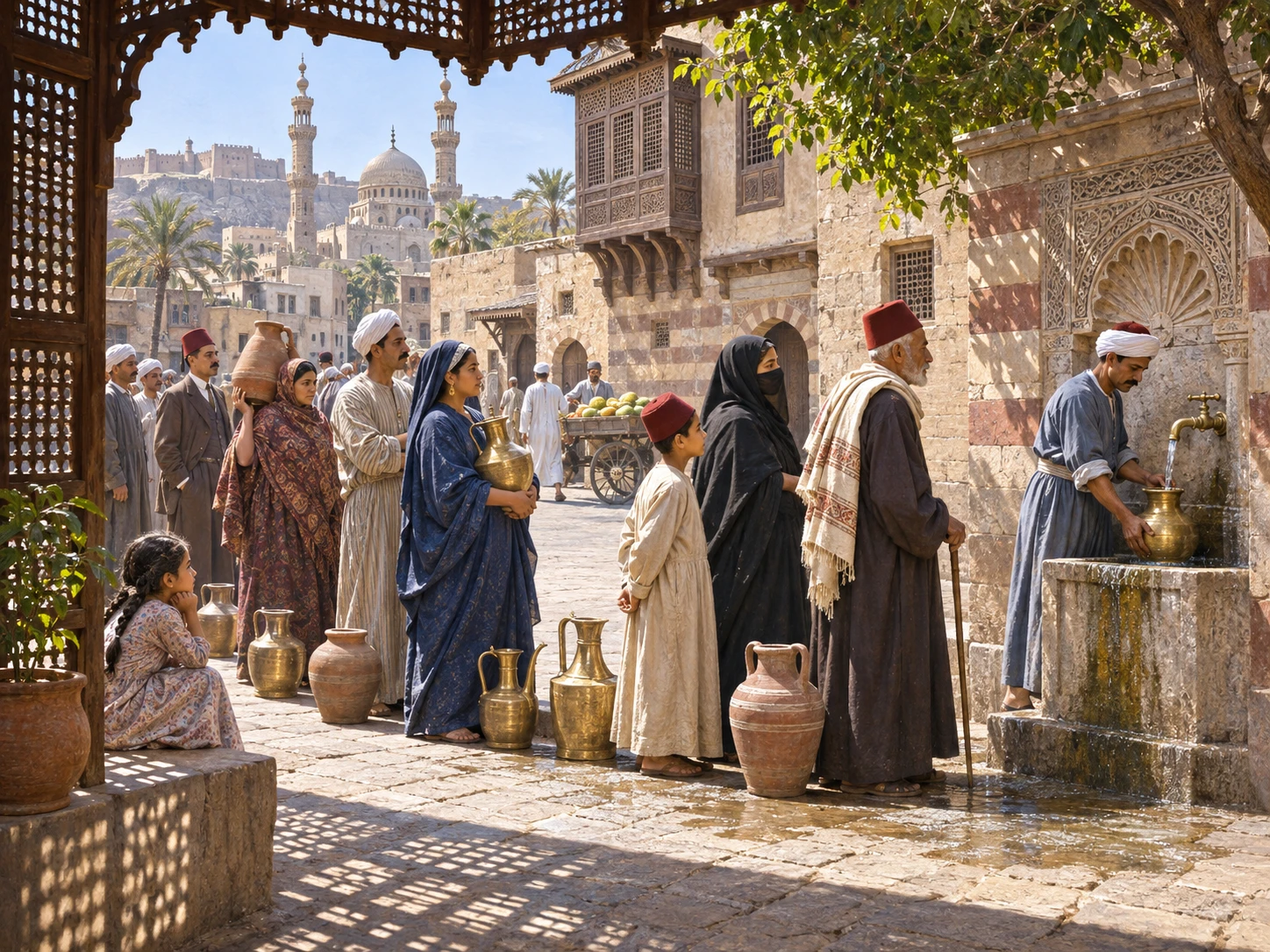
Early-twentieth-century photographs preserve people waiting at public water taps in Cairo. The Keystone-Mast Collection at the University of California, Riverside, contains stereographs made between about 1900 and 1935 at Egyptian taps. Cairo scenes show people holding pots or goatskin bags and waiting their turn. One image contains at least seven people in line; another captures the next carrier preparing his bag while the person ahead draws water.
The queue did not belong to a city without water infrastructure, but to one where the network expanded unevenly. From the later nineteenth century, the Cairo Water Company served newer and wealthier districts first, while taps remained scarce in the dense old city. People walked to the available source and absorbed, one turn at a time, the labor of filling and carrying heavy containers. Professional carriers, municipal street-waterers, and residents could all depend on the same limited points.
The inherited nineteenth-century date remains important as the period in which the commercial network took shape, but the direct photographic evidence of the line belongs to roughly 1900–1935. The country, city, and waiting target—water at a public tap—are unchanged; only the period has been corrected to the traceable images. Modernization did not simply erase waiting. It could concentrate it in front of a single spout.