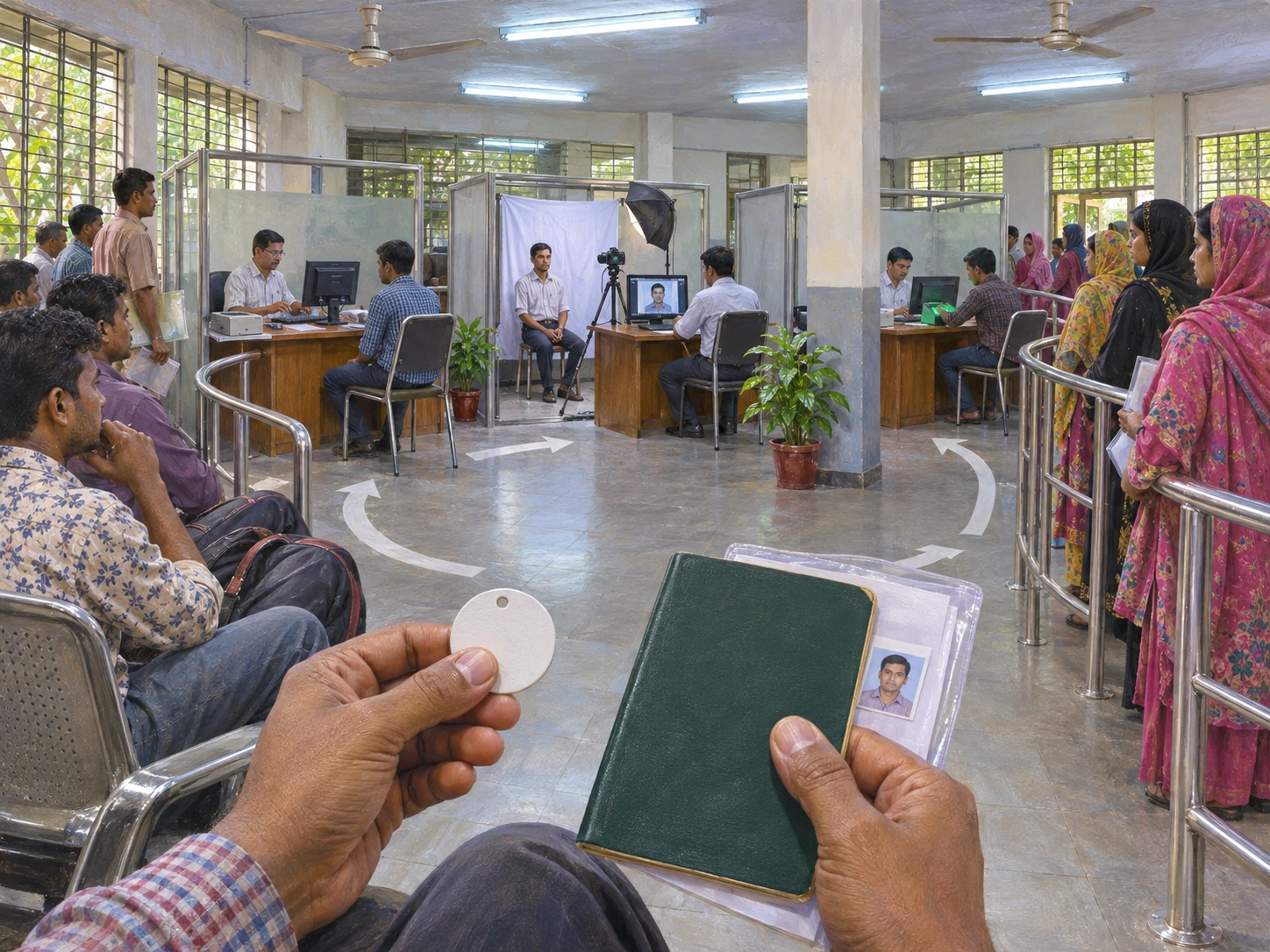
The journey to a job abroad begins before the airport. In Bangladesh, aspiring migrant workers must complete government registration and record biometric data linked to a digital smart card. A 2018 field study supported by the International Organization for Migration (IOM) and the International Labour Organization (ILO) describes this not as an abstract application process, but as a wait governed by tokens and serial numbers.
Applicants fill in a paper form, pay a service charge, and attach copies of a valid passport and destination-country visa. They then collect a token showing the order in which they will be served before moving through data entry, photography and fingerprinting. The service was provided at District Employment and Manpower Offices (DEMOs) and branches of Probashi Kallyan Bank (PKB), a bank created for migrant-worker welfare. Women visiting for biometric registration waited in a separate queue reserved for them. According to the report, the full process could take from a few hours to a day depending on the length of the queue, with especially heavy demand during the first two working days of the week.
The line led to more than a fingerprint record. It was an entry point to overseas work, remittances and a family's plans. A numbered token may look trivial, yet here it carried unusual weight. The familiar act of waiting for a counter linked one person's turn to a much larger crossing of borders.