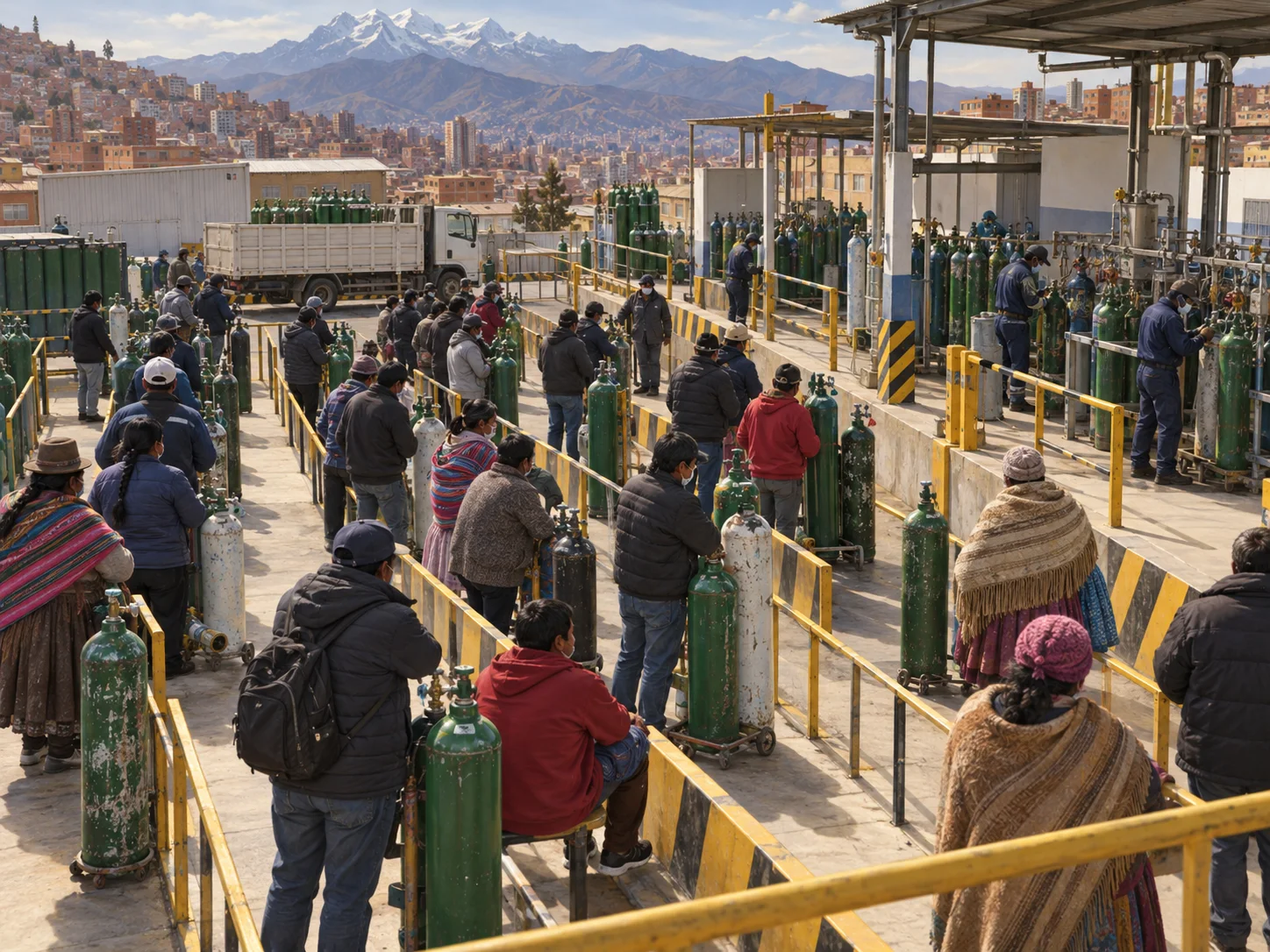
Families in Peru guarded both their place and the possibility of carrying oxygen home.
As hospital beds ran short, more patients depended on oxygen at home. The person in line was usually a relative able to travel and wait. At home, the remaining supply was falling; outside the plant, progress was difficult to see. Caught between those two clocks, families could neither abandon their place nor wait with confidence.
When demand exceeded production, a medical decision was displaced into first-come order outside a plant.
In July 2020, Bolivian families carried empty oxygen cylinders to refill points and waited for one, two or sometimes three days. La Razón described people sleeping near the line and holding on to uncertain promises about the next delivery. A cylinder was heavy enough to carry, but useless to a patient until it was filled.
Their persistence deserves recognition, but not romantic treatment. Life-supporting equipment had come to depend on a household's ability to search, pay and remain awake outdoors. The line of empty cylinders made an invisible shortage physically visible. It showed how heavy absence can become when a health system runs out of breath.
The empty cylinder became proof of need and an anchor holding its owner in line.
The Bolivian report records families waiting one, two or three days to obtain medical oxygen in 2020.