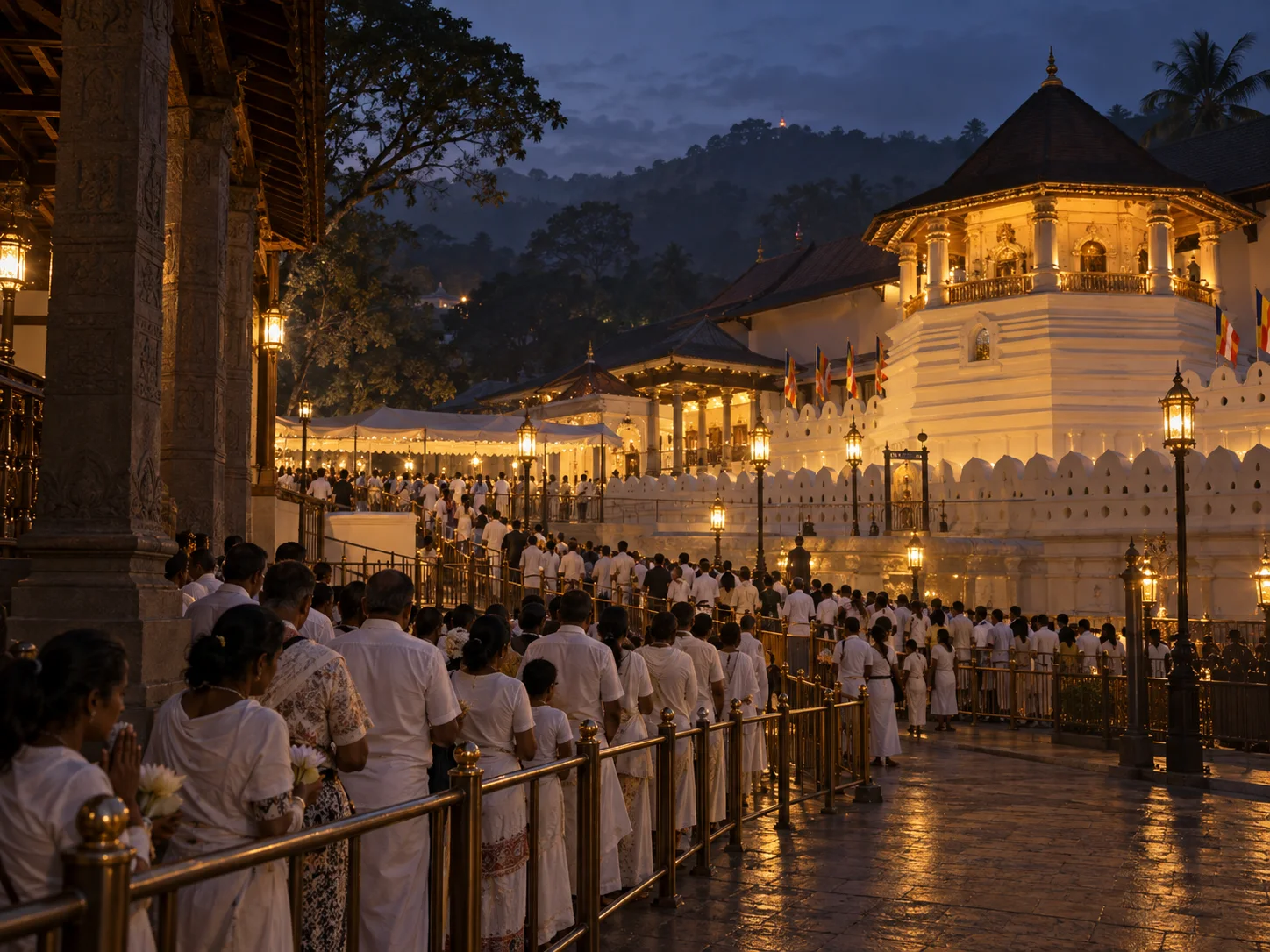
In April 2025, pilgrims gathered in Kandy, Sri Lanka, for a rare public exposition of the Sacred Tooth Relic, traditionally believed to be a tooth of the Buddha. It was the first such exposition in sixteen years. The event ran from 18 to 27 April. By the penultimate day, local reporting described a queue stretching roughly five kilometres along the Katugastota approach.
This was not a line in which the destination gradually came into view as people shuffled forward. Pilgrims might wait for many hours, yet their moment in front of the relic was extraordinarily brief. The Sunday Times reported that only three people were admitted at a time for a fleeting act of veneration. The distance travelled and the time spent waiting were immense compared with the duration of the encounter itself.
Managing the crowd required more than barriers. Police used passes to allow people to step out temporarily for personal needs, as well as stickers intended to control re-entry. On 25 April, authorities announced that new arrivals would no longer be permitted to join the lines. Reporting by The Morning on 27 April also documented hospitalisations and deaths during the exposition. Admiration for devotion must not erase the physical risks involved in such extended waiting.
Why stand for so long for a moment so short? No outsider can give a single answer on behalf of every pilgrim. For some, the rarity of the chance may have made that instant all the more valuable. Seen only as an inefficient way to look at something, the queue makes little sense. Seen as an encounter shaped by faith, scarcity of opportunity and the demands of public safety, it becomes a far more complicated human event.
The five-kilometre line measured not the capacity beside the coffin, but the scale of a society moving in the same direction. A glimpse lasted seconds; the road became the waiting room required to obtain it.
Ahead of the final day of the Sacred Tooth Relic exposition on 27 April 2025, reporting said attendance had exceeded one million while thousands remained in queues. A brief act of worship required the city to reorganise crowd control, medical support and basic services around waiting.