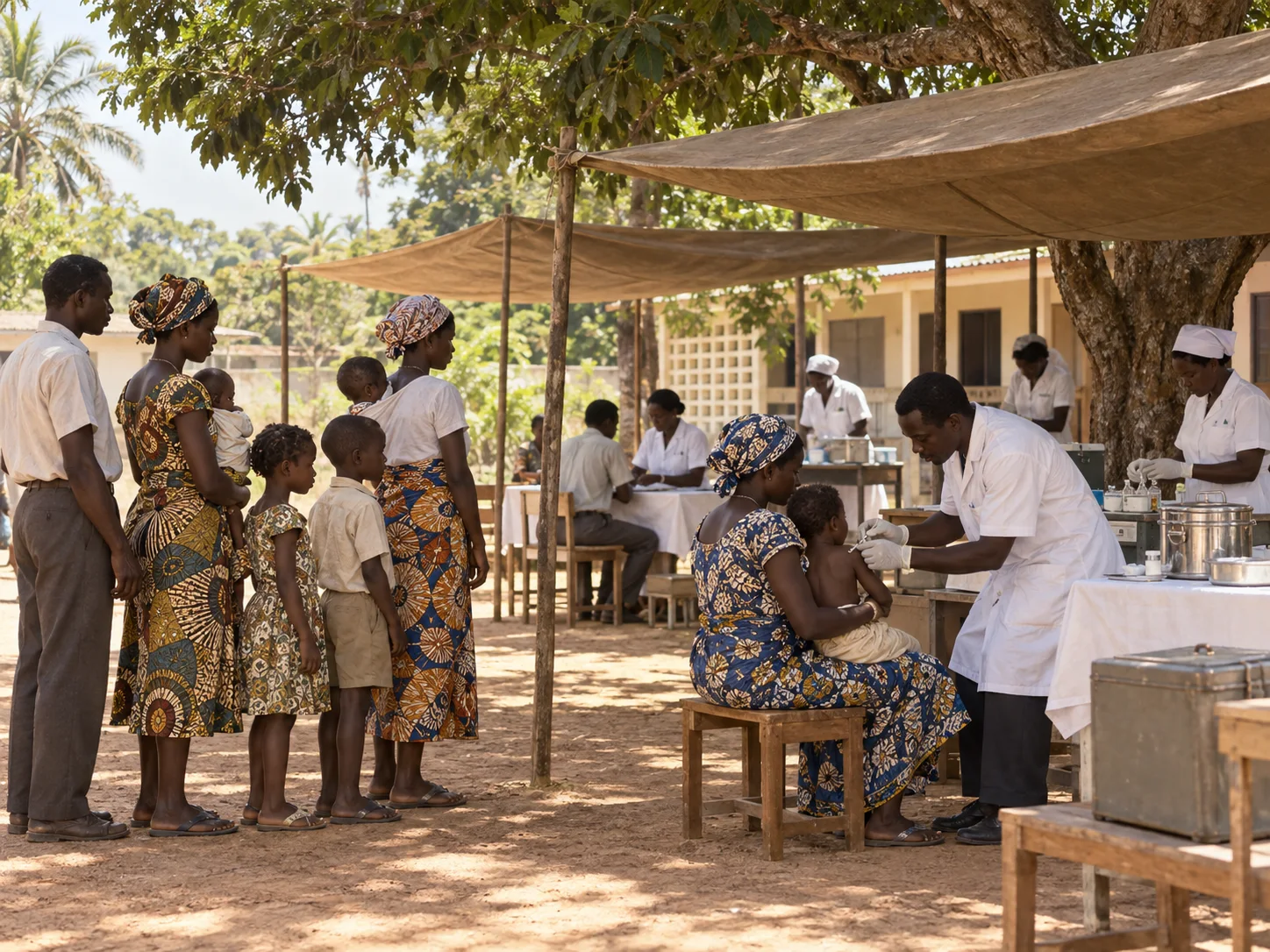
During the 1970s, villagers in Côte d’Ivoire lined up for smallpox vaccination at an outdoor clinic. The World Health Organization preserves the scene in its photo story on smallpox vaccination. The caption is brief but direct: it identifies villagers, a queue, an outdoor clinic, the country and the purpose of vaccination.
An eradication campaign could not rely only on permanent hospitals and on people able to travel to them. Vaccination teams had to bring staff, equipment and supplies to communities, then create a temporary route through which recipients could be registered and treated. The outdoor line was evidence of that reversal. Instead of a medical building waiting for patients, a medical service had moved closer to where people lived.
The WHO page does not give the village name, the number of people, the waiting time or the vaccination device used. Those details cannot be reconstructed from the image. What can be said is more specific than the general claim that a campaign occurred: villagers waited in an ordered line at a temporary clinic to receive a procedure one by one.
At a permanent hospital, architecture defines the entrance, reception area and treatment room. At a temporary outdoor clinic, the queue itself helps create those boundaries. A line can connect the point of arrival to the person administering vaccine even when walls and corridors are absent. The global effort to eliminate one disease depended on thousands of such local, temporary entrances. When the team moved on, the clinic’s physical form disappeared, while vaccination records and immunity remained. Temporary queues allowed the programme to create capacity without constructing permanent facilities everywhere.