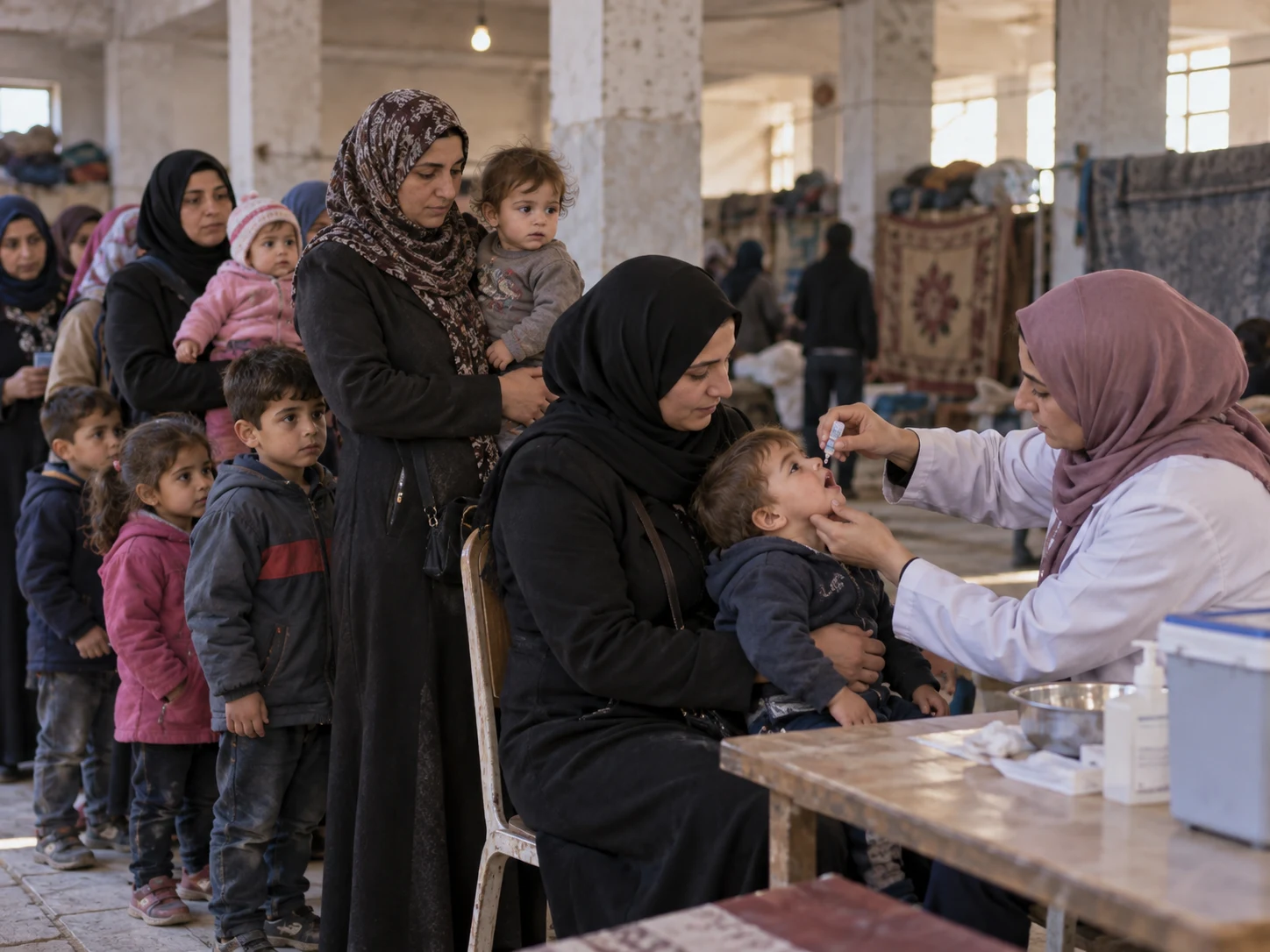
On 3 February 2014, a queue had already formed at Mohammed El Durra School in Homs, central Syria, before three volunteer polio vaccinators arrived. The school had been converted the previous year into a shelter for more than 500 displaced people. A contemporary report from the World Health Organization’s Eastern Mediterranean Regional Office fixes the place, date, purpose and presence of the queue in the same scene.
Families were waiting to have children under five receive oral polio vaccine. One mother said it was the third time her two children had been immunized at the shelter. On the first day of the February vaccination round, 120 children living there were vaccinated in less than two hours. In a setting where many parents and children had to be guided safely through a limited session, the line was part of how care could be delivered.
Syria had confirmed a polio outbreak in October 2013, the country’s first since 1999. The national campaign supported by WHO and UNICEF sought to reach children cut off from routine health services by conflict and displacement. The shelter queue therefore joined two scales of waiting: a family’s immediate turn for a child, and the collective work of stopping infection from spreading.
The setting is far from ordinary life, yet the act of watching over a child’s place in line is widely recognizable. The value of this record lies in its precision: a named school, a dated vaccination round and an explicitly reported queue, rather than a general image of a crowd.