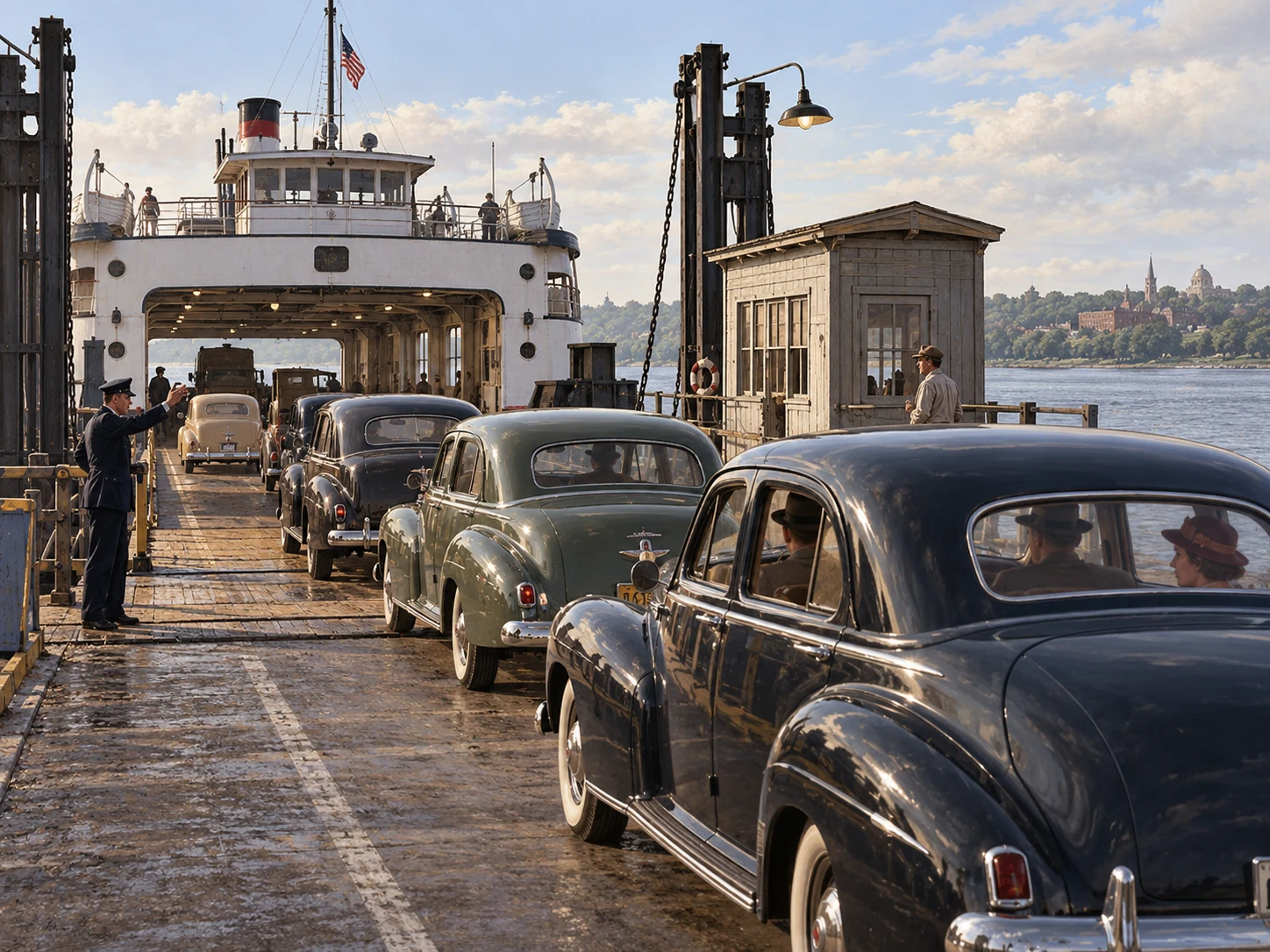
In July 1940, automobiles and trucks waited in line at the dock in Little Creek, Virginia, to board the ferry SS Princess Anne. The Library of Congress catalogue explicitly identifies the queue in a group of photographs made by Farm Security Administration photographer Jack Delano. The route crossed to Cape Charles from a dock promoted as the “gateway to the South.”
Among the travellers were migrant agricultural workers heading from Florida to Virginia’s Eastern Shore. The photographic group covers not only the waiting vehicles but also a bus and truck aboard the ferry, passengers and a watertight door. Vehicles that had travelled independently by road had to gather at the water’s edge and be reordered according to the ferry’s boarding process before continuing.
The catalogue supplies no measured line or waiting time, and none is inferred. What it does preserve is a set of thirty-one photographs treating vehicles, passengers and shipboard space as parts of one transport system. This was not simply congestion outside a leisure attraction. The queue formed at the point where travel—including the movement of seasonal labour—changed from road to ferry. Where the highway met water, forward movement depended less on an engine than on a place in the boarding sequence.