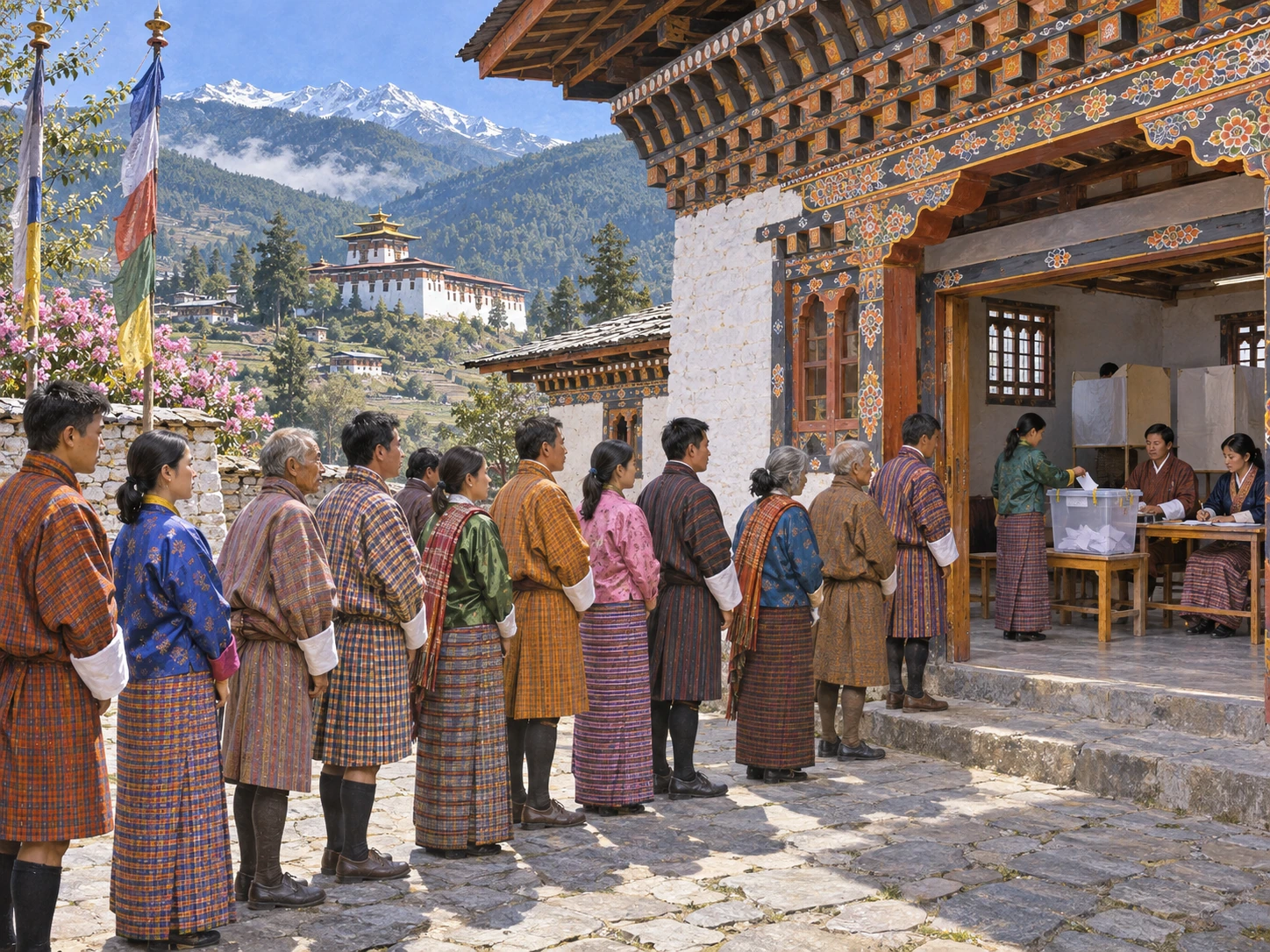
On 24 March 2008, Bhutanese voters formed long lines outside polling stations for the kingdom's first National Assembly election. Reuters' photographic record shows people carefully dressed in traditional clothing waiting to choose between political parties for the first time in the Himalayan kingdom. In Babesa village, some waited nearly two hours to cast a ballot.
This was not an election won after a popular movement overthrew a monarch. It was prepared as part of a king-led transition to constitutional monarchy, with two parties contesting 47 seats in the National Assembly. Bhutan's Election Commission records turnout of 79.38 percent in that election.
The unexpected feature of this queue is that the monarchy prepared the place for voting before public pressure forced it to do so. Wearing traditional dress, citizens advanced toward electronic voting machines, carrying an old symbol of the kingdom into a new institution. The line became one of the first public spaces in which Bhutan practised parliamentary democracy.