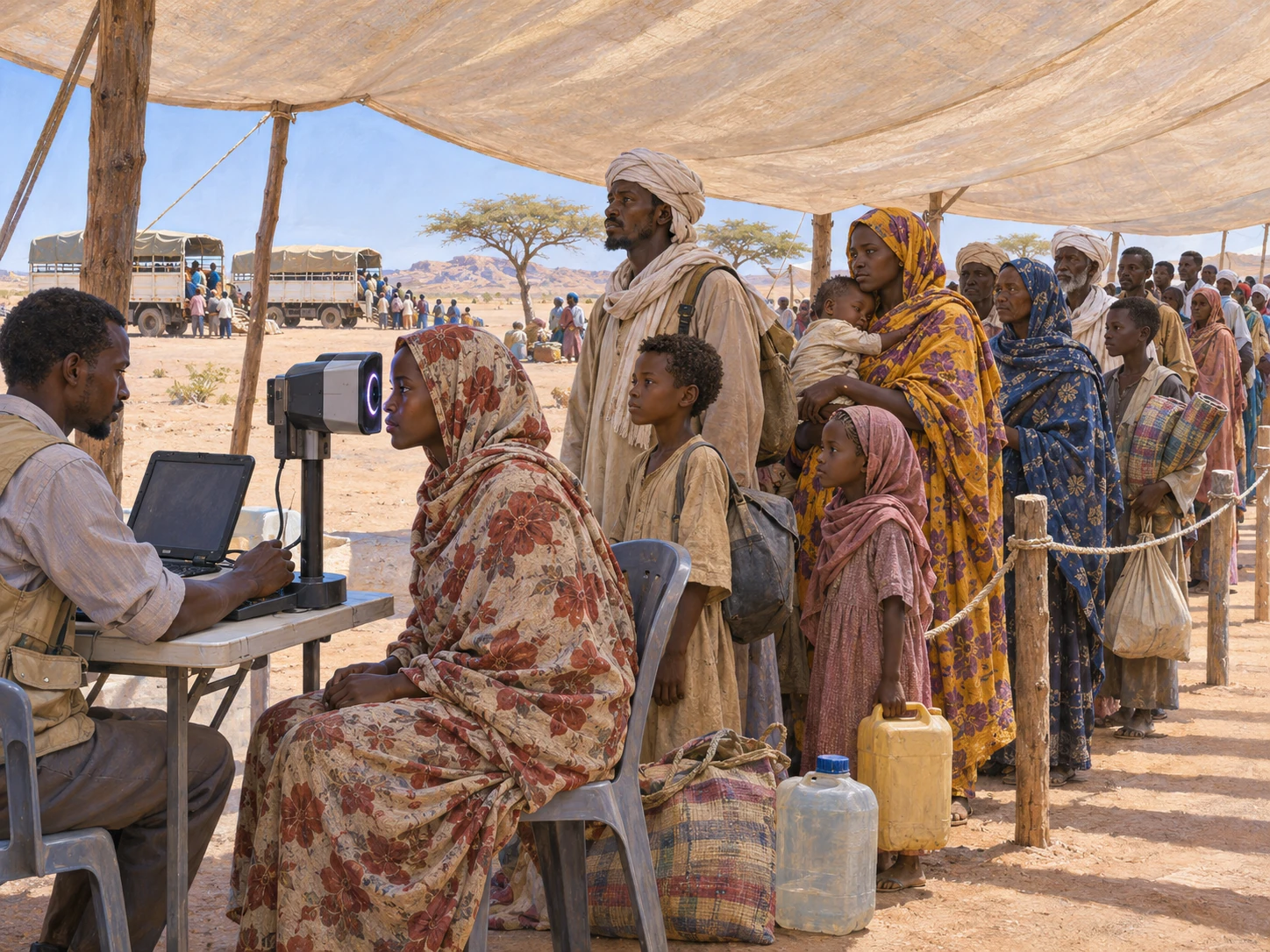
Sudanese refugees who had crossed into Chad formed a biometric-registration queue before boarding trucks to settlements farther inland. A UNHCR report published in 2025 includes a photograph of a young girl holding her eyes to an iris-scanning device while other displaced people wait behind her. After registration, families boarded vehicles with their belongings for relocation to sites where assistance and shelter were organized.
The queue shows that crossing a border does not complete the administrative journey of flight. UNHCR and the Chadian authorities register arrivals so that protection and aid can be linked to identifiable individuals. Iris data can help preserve a unique record even when papers have been lost, but it also means that people escaping violence must pass through a new institutional threshold—capture and verification of identity—before moving on to a place of residence.
At the head of this line was more than a document. Registration led directly toward a place on a truck and a settlement connected to life-saving support. The report noted that vulnerable people, including those who were sick, disabled or elderly, travelled in smaller vehicles, while other families waited with their possessions to board trucks. What distinguishes this queue is the way identification and movement were joined into one sequence. Waiting turned a mass arrival into individual records, and those records became part of the route from a border reception point to the next stage of refuge.