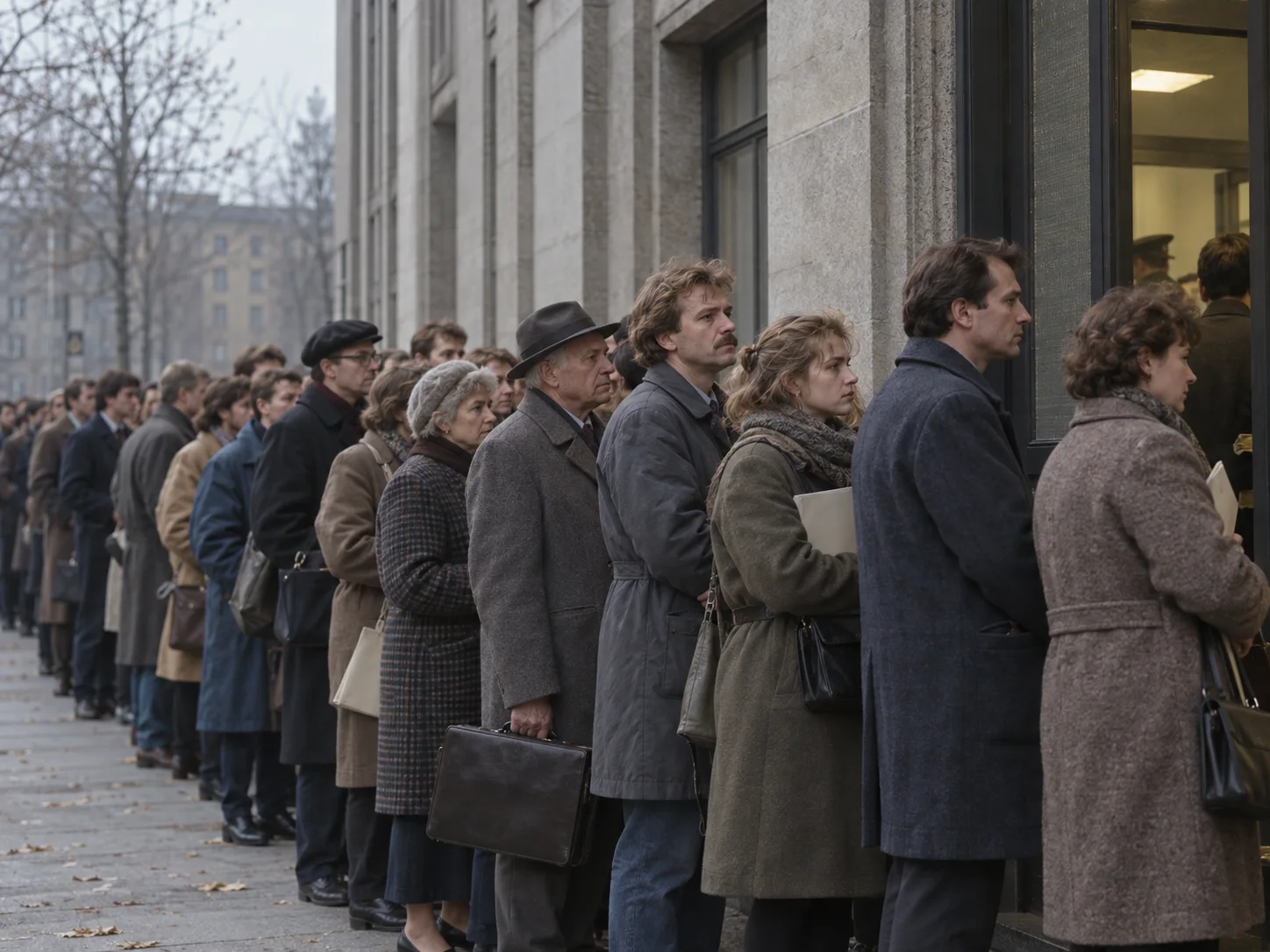
On the night of 9 November 1989, the border dividing East and West Berlin effectively opened. The next day, long lines formed at district offices of the East German People's Police. The Chronicle of the Berlin Wall records those visa queues. When we imagine the fall of the Wall, we usually see crowds cheering at the crossings or standing on the concrete barrier. Yet another image belongs to the same historic morning: people waiting their turn at an administrative counter.
The announcement the previous evening had been widely understood to mean that new travel rules took effect immediately. People hurried towards the border. Others went to police offices to obtain the documents that would make a journey possible. According to the Chronicle, officials did not always follow the procedure originally envisaged: visas were stamped onto identity cards, and a passport was not required. The rules were being overtaken by the people trying to use them. What clerks did at their desks changed as events unfolded outside.
A queue does not reveal the private wishes of everybody in it. Some people may have hoped to visit relatives; others simply wanted to see the other side; still others could have felt an urgent need to leave. Those are possibilities, not individual stories established by the source. What the record does establish is extraordinary enough: in a state that had tightly controlled travel, people were suddenly queuing in large numbers for permission to move.
Sometimes a line shows that an institution still holds power. Sometimes it shows that the institution's power is being transformed. On 10 November 1989, the visa queues did both. The phrase 'the fall of the Berlin Wall' can make change sound instantaneous. At the counter, it was also made of ordinary things—identity cards, ink stamps, office hours and the person who had arrived before you. The world had changed overnight; paperwork had not disappeared with it.
The morning after the Wall opened, freedom of movement did not instantly become freedom from paperwork. The consular queue showed an administrative border surviving a political one.