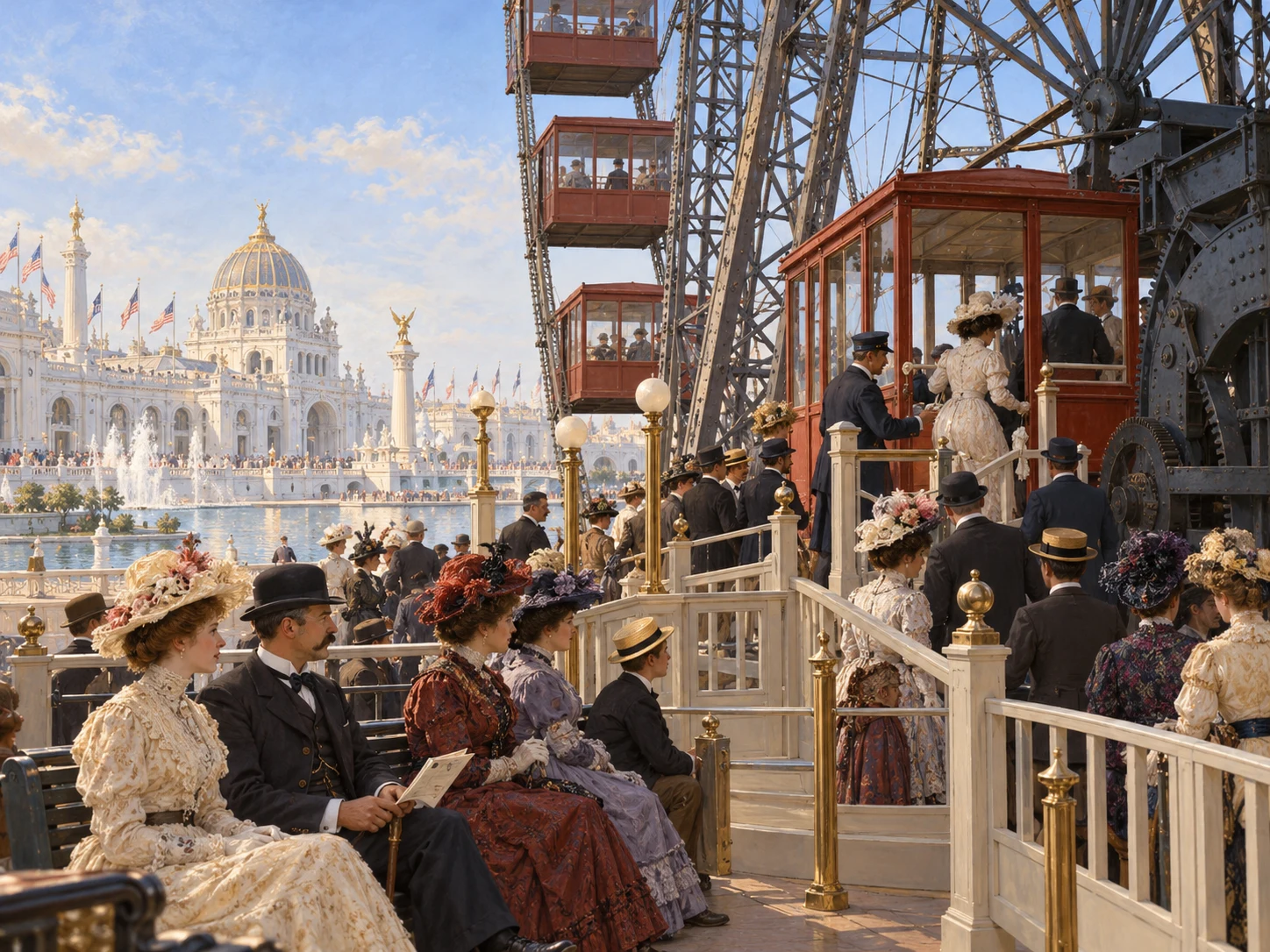
At Chicago's 1893 World's Columbian Exposition, visitors waited to board a wheel roughly seventy-six metres in diameter. George Ferris's structure carried thirty-six passenger cars. Each car held many people, but boarding and unloading occurred at fixed points in a controlled sequence. Library of Congress exposition photographs preserve the wheel, its cars and surrounding crowds on the Midway.
The ride was conceived as an American engineering answer to the Eiffel Tower. Unlike a monument merely viewed from below, it physically lifted its audience. Yet the appearance of mass transport concealed a narrow intake point. A car stopped, passengers changed, safety was checked and the wheel moved again. The ground queue advanced according to the rotation of the machine.
The photographs do not justify a precise claim about individual waiting time. They do make the mechanism of waiting clear. Fairgoers entrusted themselves to a giant machine for entertainment rather than urban travel. To obtain a few minutes above the exposition, they first remained on the ground until the iron wheel delivered their particular car.
The cars were huge, but the wheel was not a continuously speeding ride. Loading required a pattern of stopping and moving as one full car rose and another approached the platform. That intermittent operation gave the line a distinctive rhythm: it advanced, paused, and advanced again while earlier passengers looked down from overhead.