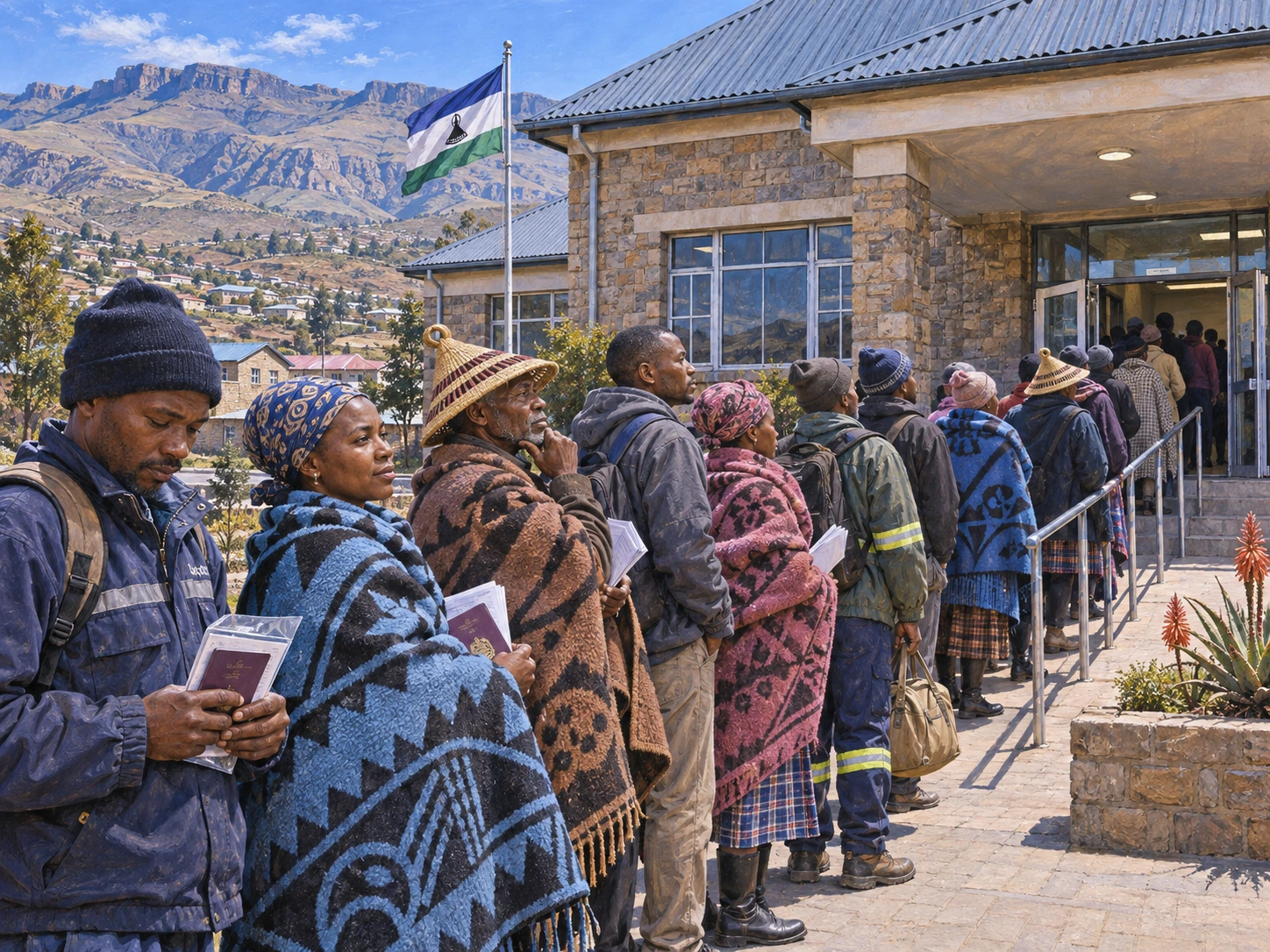
By 2:30 in the morning, roughly thirty names were already on a waiting list outside a passport office in Mohale's Hoek, Lesotho. Some people had arrived as early as 7 p.m. the previous evening. Public services would not begin until 8 a.m. Yet for migrant workers trying to return to jobs in neighbouring South Africa, the wait had started many hours earlier.
Reporting published in January 2026 described the surge around the Christmas and New Year period, when Basotho workers returned home and tried to renew their documents before travelling back. One domestic worker employed in Johannesburg said she had already been turned away on Christmas Eve. She returned after midnight, only to face a sequence of administrative requirements: her national identity card had to be renewed before she could apply for a passport, and she was told to wait another twenty-four hours once the ID was ready. Reaching the counter was not necessarily the end of the process.
The backlog had several causes. Lesotho began issuing national identity cards in 2013, and their ten-year validity meant that renewal cycles had begun to overlap. Mohale's Hoek was also a production bottleneck: passports were made there before being distributed to the country's other districts. A person whose livelihood depended on a job across the border could not simply choose to return another month. Workers interviewed by journalists described repeated visits, overnight waits and the fear of losing employment.
The authorities responded by extending office hours and opening passport and ID facilities on weekends. But the reporting also followed some migrants who, unable to obtain documents in time, crossed rivers into South Africa without authorisation. Such crossings carried serious dangers, especially after heavy rain.
A passport queue and a river crossing may appear to be entirely separate scenes. Here they were linked by an administrative delay. Those waiting through the night were seeking a document, but what was at stake was the ability to get back to work without taking a dangerous alternative route.
Between the 2:30 a.m. waiting list and the 8 a.m. opening lay five and a half hours the office did not count. For cross-border workers, those hours helped decide whether they could return to their jobs.
Local reporting found about 30 names on the list at Mohale’s Hoek by 2:30 a.m.; some people had arrived at 7 the previous evening for an office opening at 8 a.m. An ID renewal could then require another 24-hour wait before a passport application, so one queue generated the next.