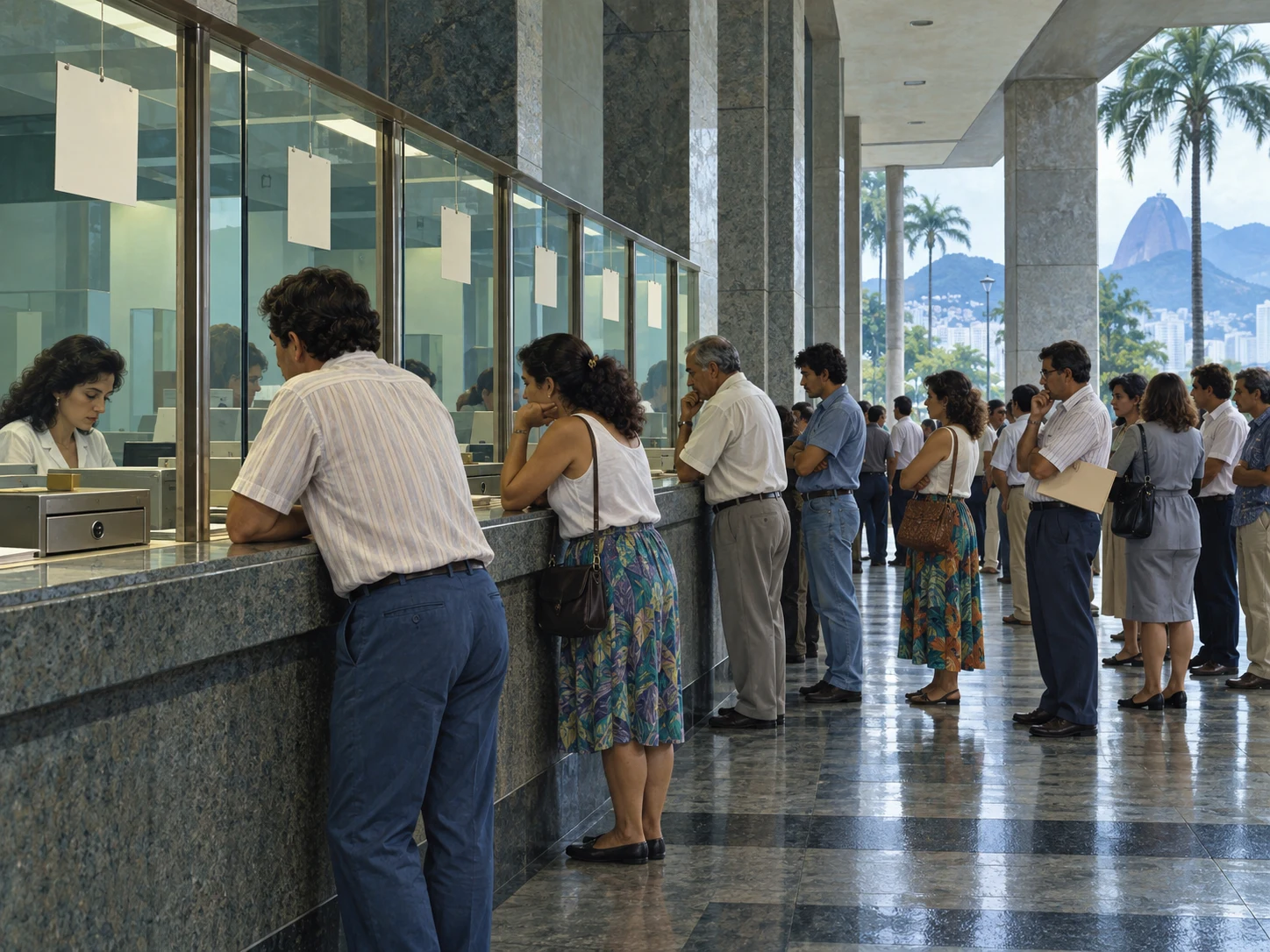
In February 1991, people queued outside a bank in Rio de Janeiro. A retrospective published by Deutsche Welle in 2024 reproduces an AFP photograph by Antonio Scorza. Its caption links the line to the Collor government's decision to permit the gradual withdrawal of savings that had previously been frozen. The striking fact is not simply that people wanted cash. The money was supposed to be theirs already; access to it had become a matter of government rules and timing.
The background was the Collor Plan of March 1990, an extraordinary attempt to halt runaway inflation. It restricted access to bank deposits and other financial assets above a specified threshold. As Deutsche Welle explains, amounts exceeding 50,000 new cruzados were blocked, generally for eighteen months. In an economy where prices were rising rapidly, being told when savings could be used had immediate consequences for households and businesses. A balance shown on paper did not automatically translate into purchasing power at the shop counter.
The newspaper's reconstruction of life before Brazil's Real currency describes a society where time itself had become part of financial calculation. Families hurried to supermarkets as soon as wages arrived; price tags were constantly replaced; people sometimes formed early-morning queues when meat was expected to be available. The queue outside the bank in 1991 belonged to that wider landscape of interrupted routines and defensive improvisation.
It would be too simple to label the photograph as a line of people eager to withdraw savings. More precisely, it recorded people waiting to regain practical access to money already held in their names. A queue may govern who gets a scarce new product first, but it may also appear when the ability to exercise an existing right has been suspended or rationed. A few metres of pavement outside a Rio bank made the distance between national economic policy and everyday life suddenly visible.
A balance could remain intact in a ledger while failing to become money for daily purchases. The pavement queue was the final conversion between a bank's numbers and cash that could actually be spent.
DW identifies a February 1991 queue outside a Rio de Janeiro bank after gradual withdrawals from frozen savings were authorised. Families also spread savings across accounts with different anniversary dates to minimise lost interest. The line was therefore part of a wider household technique for trying to move faster than inflation.