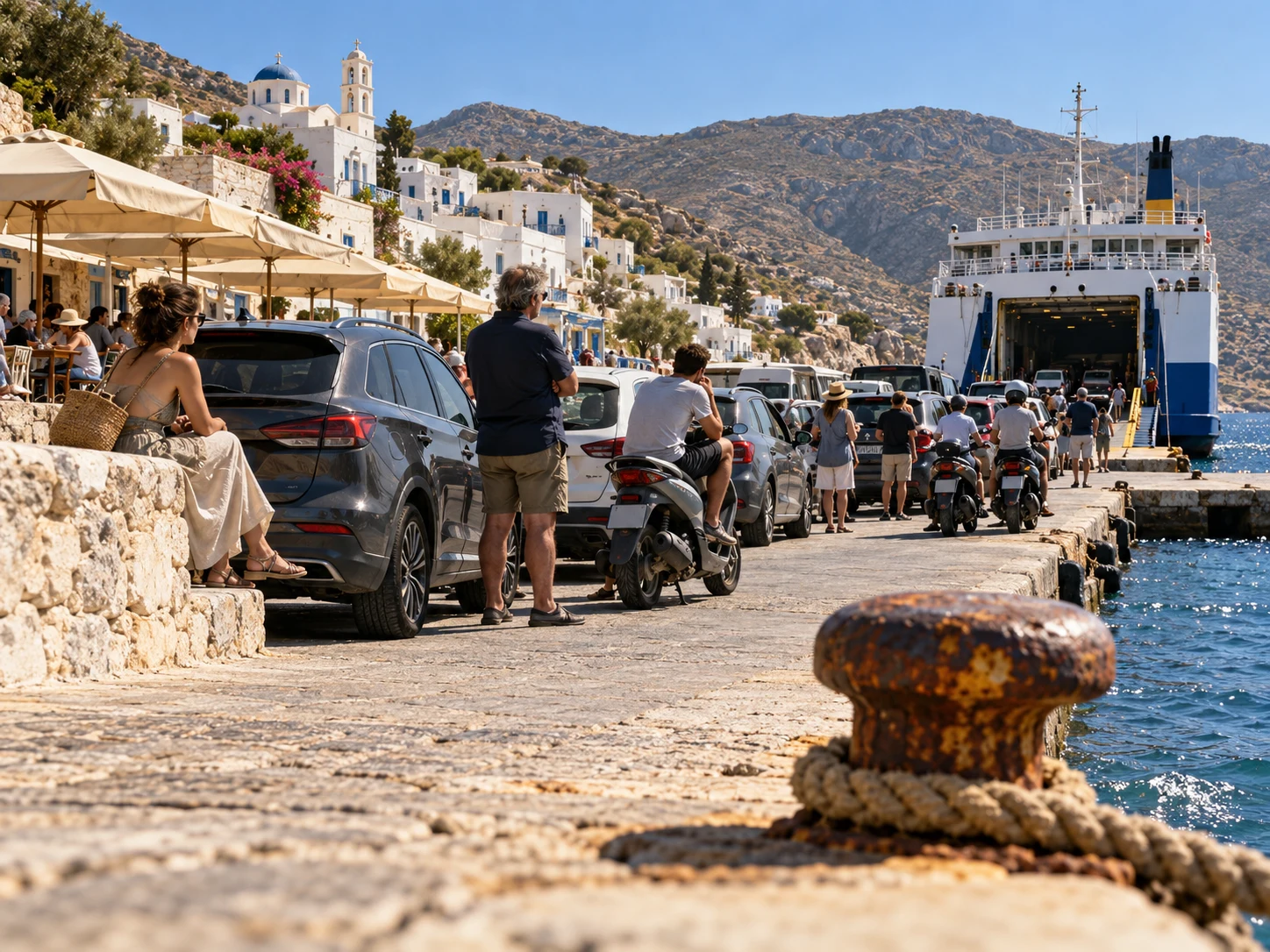
When travelling by car to a Greek island, the ferry queue begins in a port holding area rather than on the vessel. Operator terms state that vehicle loading order follows port-authority rules, and passengers must arrive early with tickets, identification and vehicle documents. Drivers leave cars in assigned positions and wait nearby for instructions.
A vehicle deck must fit objects of different sizes into limited space. Loading cannot be a simple first-come sequence: trucks, cars and motorcycles must be arranged safely, sometimes with the order of discharge at later ports in mind. The earliest car may not enter first; the queue becomes input to a stowage plan.
In a line of people, closing a gap is easy. In a line of vehicles, every movement requires the driver, and the parked car itself holds the place. The port area can look like an ordinary car park, but it is actually a queue spread across a surface, preparing the internal geometry of the ship while still on land.
Several decisions sit between this queue’s entrance and exit. A single line can preserve arrival order, but verification, classification and allocation turn it into an operating chart for an institution. People move forward while being translated into categories the system can process.