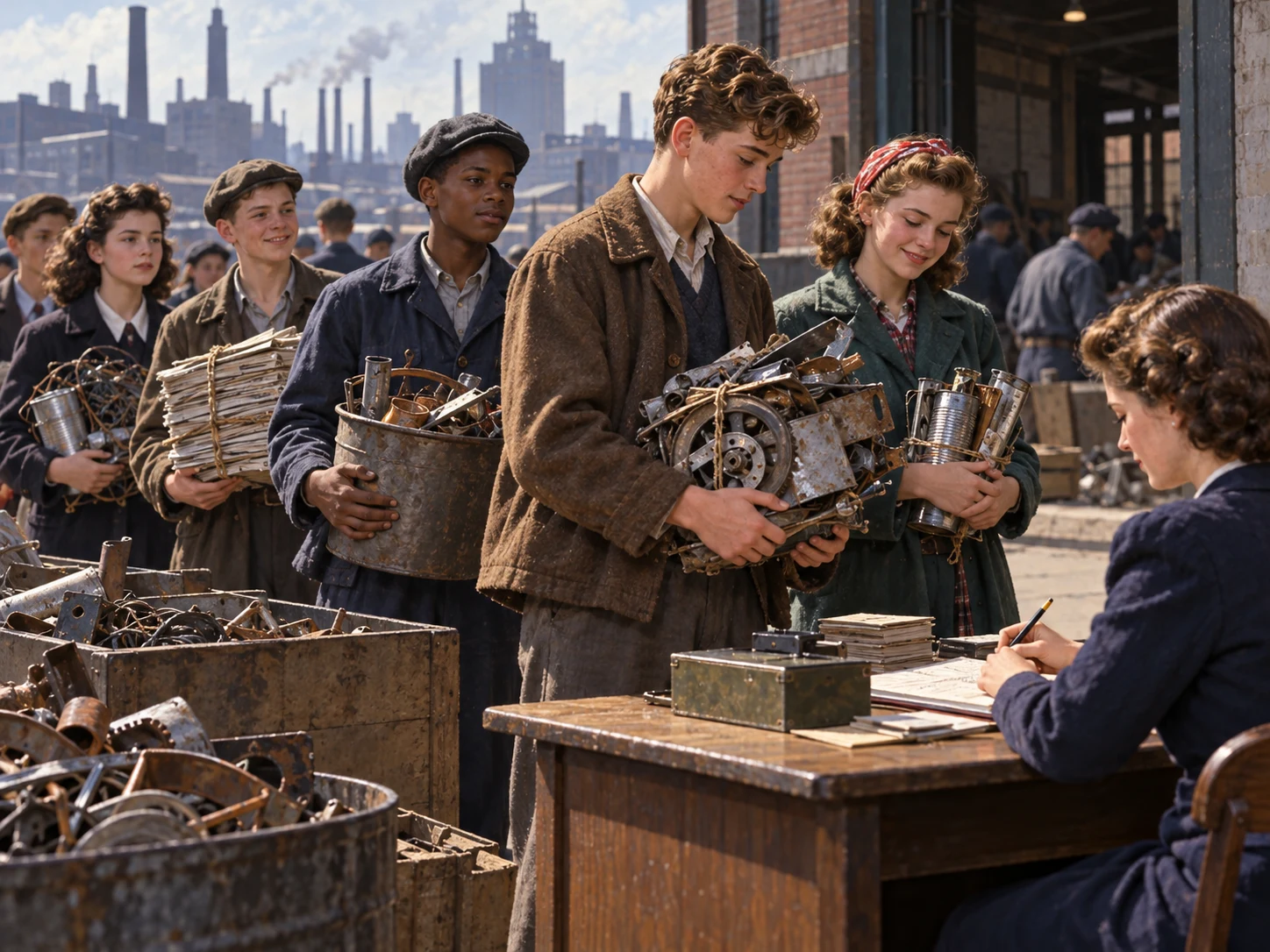
In July 1942, white and Black youths in Detroit formed a line to register for a wartime salvage drive. The Library of Congress catalogue identifies the photographer as Arthur S. Siegel and explicitly states the purpose of the line. This is not a queue inferred from the arrangement of bodies in an old photograph; the archive's own caption confirms the ordered wait.
Salvage drives linked ordinary urban life to a distant war by collecting materials such as metal and rubber. The image is especially striking because it brings young people of different backgrounds into one registration line during an era of deep racial segregation. The photograph cannot tell us what they thought of one another. It does establish that they waited in the same place, for the same practical task, each approaching registration in turn.